



How to Find Inner Peace in 5 Minutes
Key Takeaways
- Five focused minutes can reliably downshift your nervous system and reset your day.
- Lengthening your exhale, naming sensations/emotions, and setting a tiny intention are high-impact levers.
- Portable practices work anywhere—desk, car, hallway—no special gear needed.
- Consistency beats intensity: pair this flow with daily cues to build a calm baseline.
- Quick resets complement (not replace) therapy, medication, and structural life changes.
Introduction
Picture this: the screen glows, the cursor blinks, and it begins to sound like a metronome for your nerves. Shoulders lifted, jaw set, breath caught somewhere high in the chest. A text lands—“Take five.” You almost dismiss it. Five minutes? For peace? And still, you slide into the restroom, click the lock, and lean your back against the cool tile. For a second you simply stand there, asking an honest question: Is it actually possible—how to find inner peace in 5 minutes—when your body feels like a siren that won’t power down?
If this scene rings true, you’ve got company. The National Institute of Mental Health estimates that roughly 19% of U.S. adults contend with an anxiety disorder each year. The American Psychological Association has logged elevated stress levels since 2020, and few of us would argue with that. The World Health Organization now flags burnout as a workplace phenomenon; back in 2021, it reported that long working hours were linked to an estimated 745,000 deaths from stroke and heart disease in 2016 alone. When the world runs this loud, learning how to find inner peace in 5 minutes isn’t self-indulgence—it’s practical hygiene for the mind.
Why Five Minutes Can Shift Your Day
Short doesn’t have to mean superficial. The stress response is malleable—biological, yes, but trainable. Well-aimed practices can reset momentum in minutes. Here’s the why before the how, because context matters:
- Breath leads the nervous system: Slow, deliberate breathing nudges the parasympathetic “rest and digest” system, steadying the body’s alarms. Harvard Health frames breath control as a core relaxation method with measurable effects on heart rate and stress arousal. My view: exhale length is an underrated lever—boring, effective, repeatable.
- Mindfulness helps you unhook: Even a brief return to the present—attention with a dose of curiosity—can reduce perceived stress and rumination. The National Center for Complementary and Integrative Health points to growing evidence that mindfulness practices help with anxiety and regulation. A few honest breaths beat a dozen motivational slogans.
- Relaxation techniques are versatile: Body scans, grounding, guided imagery—portable tools with solid safety records. You can use them at a kitchen counter or on a park bench. The Mayo Clinic has laid out simple exercises for precisely these in-between moments.
“You don’t need an hour on a cushion to interrupt a stress spiral. You need a switch—something you can do right now that tells your body ‘you’re safe.’ Five minutes can be that switch.”
— Dr. Sarah Chen, PhD, Clinical Psychologist at NYU
I agree; it’s less about willpower than about giving your physiology a cue it recognizes.
A Five-Minute Flow That Actually Works
In a perfect world, you’d have a quiet room and a warm throw. Real life offers a parked car, a bathroom stall, a narrow slice of shade outside your building. This sequence shows you how to find inner peace in 5 minutes wherever you’re standing—no apps, no incense, no fuss.
1) Land in Your Body (About 60 Seconds)
Why it works: Stress pushes us into mental overdrive. Sensation pulls you into the present and lowers cognitive “spin.”
How to do it:
- Sit or stand and notice three points of contact: feet on the floor, seat on the chair, hands resting.
- Label five neutral sensations: “cool air on skin,” “weight of shoes,” “fabric on arm,” “sound of traffic,” “light behind eyelids.”
“Sensations are anchors. The more you name them, the less your thoughts yank you around.”
— Kendra Lee, Meditation Teacher & Breathwork Facilitator
My take: naming is not fluff—it’s a steering wheel.
2) Breathe to Shift Gears (About 90 Seconds)
Why it works: Longer exhales activate vagal pathways and cue a calmer state. It’s one of the quickest inputs we have.
How to do it:
- Try a 4–6 breath: inhale through the nose for 4, exhale through the mouth for 6. Repeat 6–8 times.
- Keep the belly soft, shoulders loose. Imagine fogging a mirror—gentle, steady.
“Think of your exhale as a brake pedal. Longer exhales tell your heart, ‘We’re okay.’ Patients are often surprised how quickly this steadies their pulse.”
— Dr. Rafael Ortiz, MD, Cardiologist at Massachusetts General Hospital
If there’s a secret here, it’s that simple mechanics can change mood faster than thoughts do.
3) Name and Normalize (About 60 Seconds)
Why it works: Brief labeling of emotions quiets intensity and lets the prefrontal cortex—the wiser, planning part—reengage.
How to do it:
- Quietly name your feeling: “anxious,” “overwhelmed,” “tired,” or “angry.”
- Add a normalizer: “It makes sense I feel this,” or “Anyone in my shoes would feel this.”
Consider it emotional grounding—contact, not avoidance. I find the sentence “Of course this is hard” does more than pep talks ever will.
4) Choose a Tiny Intention (About 60 Seconds)
Why it works: A small, concrete focus restores a sense of agency. Micro-intentions are easier to honor, which calms the system further.
How to do it:
- Pick one: “Today I’ll speak kindly to myself,” “For the next hour, I’ll finish one task,” or “I’ll drink water before my next meeting.”
- If it helps, add a note of gratitude—a well-documented mood booster: “I’m grateful for my friend’s text.”
My bias: if your intention can’t fit on a sticky note, it’s probably too big for a frazzled brain.
5) Seal It With a Cue (About 30 Seconds)
Why it works: Repetition paired with a physical cue turns a routine into a reflex.
How to do it:
- Close with a signal: press thumb to forefinger, hand over heart, or glance at a calming image. Let that cue mean “I’m back.”
This is how a practice becomes a pocket habit—quick, private, dependable. Its power is in the return.
Real Life, Five-Minute Peace
Maya, 28, was finalizing a divorce while learning a new job. She used to white-knuckle through panic at her desk. After practicing how to find inner peace in 5 minutes using the sequence above, she began stepping outside before big calls. “I thought five minutes was pretend-help,” she told me. “But now my hands don’t shake when I speak. That 4–6 breath is the first thing I do, every time.” In my experience, skepticism often melts after the third or fourth honest try.
Jordan, 31, a nurse on 12-hour shifts, keeps a three-step version for peak chaos. In the supply room: 30 seconds of naming sensations, 60 seconds of slow exhales, and a tiny intention—“One patient at a time.” The ritual doesn’t shrink his workload. It changes how his body carries it. That’s the point.
The Science Under the Softness
If you’re skeptical, fair. Let’s connect “soft” practices with the harder edges of physiology:
- Breath and the stress response: Breath-focused relaxation can interrupt the sympathetic “fight–flight” cascade, lowering heart rate and perceived arousal. Harvard Health has outlined this for years. My editorial note: mechanism matters here—it’s not magic, it’s vagal tone.
- Mindfulness basics: Even short, regular practices reduce perceived stress and rumination, according to NCCIH summaries. In plain terms: the reps count more than the minutes.
- Everyday tools, anywhere: Body scans and grounding require nothing but attention and air. That’s why you can genuinely learn how to find inner peace in 5 minutes—and not only on retreat.
Quick Scripts for Common Moments
-
Before a tough conversation
Why: The brain anticipates social threat; breathing slows reactivity.
Try: Two cycles of 4–6 breathing. Silently say, “I can pause before I respond.” Rest one hand on your chest to cue softness. You’re practicing how to find inner peace in 5 minutes, not auditioning for calm perfection.
-
Mid-commute anxiety
Why: Crowds and delays heighten vigilance.
Try: Choose one sense to follow—sound or sight. Label five details you notice. Inhale 4, exhale 6 for six breaths. Tiny intention: “I’ll listen to one song I love.” Small joys are stabilizers.
-
Sunday scaries
Why: Anticipatory stress loops tomorrow’s to-dos.
Try: Three rounds of exhale-lengthened breaths. Name the feeling: “nervous and heavy.” Normalize it. Jot one to-do and one kind sentence to yourself. That’s how to find inner peace in 5 minutes at home—less doom, more direction.
Troubleshooting: When Five Minutes Feels Impossible
- “My thoughts won’t stop.” They don’t need to stop—just widen the frame to include sensation and breath. Thoughts can ride shotgun; they don’t have to drive. Think of it as turning down the volume, not changing the station.
- “I don’t feel calmer right away.” Scan for micro-shifts: an easier jaw, a slower blink, a longer exhale. Those are green shoots. Physiological change often whispers before it speaks.
- “I forget to do it.” Pair your five-minute reset with anchors you already have: after you park, before the inbox, while coffee brews. Habit science loves a cue; so does a tired brain.
“Peace is learned in small sips. The sip you take now teaches your body what to do next time.”
— Dr. Sarah Chen, PhD, Clinical Psychologist at NYU
Make It Stick With Micro-Habits
If you want how to find inner peace in 5 minutes to become ordinary, treat it like brushing your teeth—low drama, high return.
- Same time, same place: Link it to morning emails or the post-lunch lull.
- Same sequence: Body, breath, name, intend, cue.
- Track it: A tiny note—“5 today”—builds momentum you can feel.
- Reward it: A glass of water, a stretch, a step into sunlight. Brains like closure and payoff.
My perspective: consistency beats intensity every single time.
The Bigger Picture
Quick resets don’t replace therapy, medication, or structural changes that reduce chronic strain. They do give you a portable, science-informed way to steady yourself when the room won’t change for you. When you practice how to find inner peace in 5 minutes across your day, you’re not bypassing feeling—you’re building capacity to feel it safely.
An Inner Peace Pocket Routine (Save This)
- Feel: Notice feet, seat, hands. Name 3–5 sensations.
- Breathe: Inhale 4, exhale 6, 6–8 times.
- Name: “This is anxiety.” “This is pressure.” “This makes sense.”
- Intend: One tiny choice for the next hour.
- Cue: Thumb to forefinger. Hand to heart. Look at sky. Done.
When Five Minutes Becomes Your Refuge
Imagine opening your laptop and feeling your breath settle low. Imagine a meeting where your voice doesn’t quiver—not because you’re fearless, but because you made space for yourself first. This is how to find inner peace in 5 minutes: not by escaping life, but by returning to it with a steadier nervous system and a kinder inner voice.
The Bottom Line
Finding inner peace can be immediate, practical, and real. Use a 5-minute flow—land in your body, lengthen your exhale, name what you feel, set a tiny intention, and seal it with a cue. Repeat at natural pauses in your day to build a steadier baseline. In one breath: start small, repeat often, let your body learn safety.
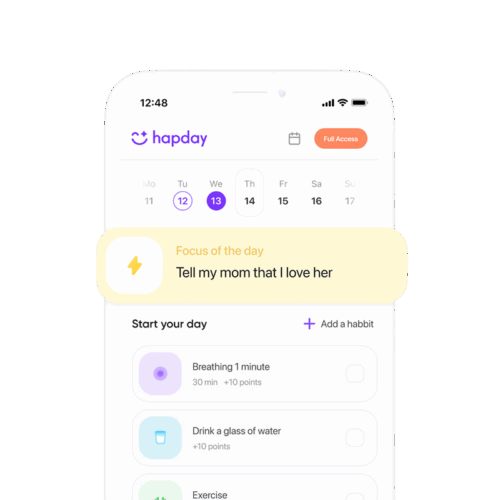
Try Hapday AI Life Coach
For guided 5‑minute resets and personalized routines, try Hapday AI Life Coach: 24/7 coaching, habit tracking, and tailored wellness programs. Download here.
About the Experts Quoted
- Dr. Sarah Chen, PhD, is a clinical psychologist at NYU specializing in anxiety and stress regulation.
- Dr. Rafael Ortiz, MD, is a cardiologist at Massachusetts General Hospital who teaches patients breath-based relaxation for blood pressure and stress management.
- Kendra Lee is a meditation teacher and breathwork facilitator who leads workplace mindfulness programs.
References
- National Institute of Mental Health (NIMH) — Any Anxiety Disorder
- Harvard Health Publishing — Relaxation techniques: Breath control helps quell errant stress response
- NCCIH — Mindfulness Meditation: What You Need To Know
- NCCIH — Relaxation Techniques for Health
- Mayo Clinic — Mindfulness exercises
- WHO — Burn-out an occupational phenomenon
- WHO — Long working hours increasing deaths from heart disease and stroke
- Harvard Health Publishing — Giving thanks can make you happier
- American Psychological Association — Stress in America (press releases)
Join 1.5M+ people using Hapday’s AI-powered tools for better mental health, habits, and happiness. 90% of users report positive changes in 2 weeks.