


Emotional Regulation Strategies You Can Use Daily
The ping came at 8:42 a.m., the kind that turns your stomach into a tiny knot. Slack message. Urgent. A client wasn’t happy. In the span of three minutes, your brain sprinted from “I’ll fix it” to “I could lose my job,” and your chest fluttered like a startled bird. If you’ve ever watched your day tilt from steady to stormy that fast, you already understand why emotional regulation matters. These are the quieter tools we use to steer our inner weather—emotional regulation strategies we can reach for daily, not just when life is falling apart.
Emotional regulation isn’t the art of pushing feelings down. It’s the practice of noticing, interpreting, and responding in ways that match your values and your aims—especially under pressure. The American Psychological Association calls it the process by which we influence which emotions we have, when we have them, and how we experience and express them. Practiced over time, these skills soften reactivity and build resilience. I’ve seen it in newsrooms and in therapy rooms; the people who do better don’t feel less, they choose more carefully.
Image description: Young adult practicing breathing on a park bench, using emotional regulation strategies during a lunch break.
Table of Contents
Key Takeaways
- Emotional regulation is about choosing your response—not suppressing feelings.
- Small, consistent practices (breath, movement, reappraisal) measurably shift your physiology and mindset.
- Link skills to cues with if–then plans to make them automatic under stress.
- Connection and sleep are powerful stabilizers that make regulation easier.
- Start with one doorway—breath, sensation, thought, movement, words, people, or sleep—and repeat gently.
Why emotional regulation strategies matter right now
When your nervous system hits fight-or-flight, your thinking brain (the prefrontal cortex) moves to the back seat while your alarm system (the amygdala) grabs the wheel. Good when you need to leap out of the street; less helpful in a tense email thread.
“We’re not trying to delete emotion—we’re inviting the prefrontal cortex back online so we can choose our next move. That’s what daily emotional regulation strategies do: they build a well-worn path to steadier choices.”
— Dr. Sarah Chen, Clinical Psychologist at NYU
A few minutes of practice can shift physiology in measurable ways. Harvard Health has reported that paced breathing activates the body’s relaxation response, lowering heart rate and easing blood pressure. The National Center for Complementary and Integrative Health points to mindfulness and relaxation techniques as useful supports for anxiety and stress. Movement—even small, unglamorous bouts—can trim short-term anxiety and nudge sleep in a better direction, which in turn steadies emotion. This isn’t wellness theater; it’s biology you can feel, often within one song’s length.
Below, seven grounded ways to use emotional regulation strategies daily—gentle, realistic practices that can live in your actual life.
Breathwork: an emotional regulation strategy you can use anywhere
Why it works
Breath is the rare system that’s both automatic and voluntary. Lengthen the exhale, slow the pace, and you signal safety to the nervous system. That cue engages the parasympathetic “rest-and-digest” response and dials down arousal. Harvard Health highlights how deliberate breathing can reduce stress and settle a crowded mind. My view: breathwork is the cheapest, most portable tool we have—and we underuse it.
How to use it today
- The 4–6 reset: Inhale through your nose for a count of 4. Exhale through your mouth for 6. Repeat for 1–2 minutes.
- The “box” for focus: Inhale 4, hold 4, exhale 4, hold 4. Do two rounds before meetings.
- Link it to a cue: Every time you sit down at your desk, do five slow breaths.
Mini-case: When Jordan, 32, a product manager, started one minute of 4–6 breathing before opening email, he noticed his “doomscroll sprint” slowed to a steady jog. “I still get stressed,” he told me, “but I feel like I’m steering—less like a passenger on a runaway train.”
Cognitive reappraisal: the emotional regulation strategy that changes the story
Why it works
Thoughts tilt the nervous system. Cognitive reappraisal—reframing an interpretation to be more accurate or helpful—reduces emotional intensity by shifting the meaning you assign to a moment. The APA describes reappraisal as altering how one perceives a situation to modify its emotional impact. In plain language: when you change the story, the body follows. It’s not spin; it’s precision.
How to use it today
- Catch the first thought, then ask: What else could be true? “They didn’t reply because they’re mad” becomes “They might be in back-to-backs.”
- Use a friend’s voice: If your best friend were here, how would they describe this?
- Write a two-sentence reframe in your notes app for repeat triggers (delayed replies, calendar reschedules, clipped feedback).
“Reappraisal isn’t about sugarcoating. It’s about accuracy. Accurate thinking calms the limbic system because uncertainty shrinks and perceived control rises.”
— Dr. Luis Ortega, Neuroscientist at Harvard Medical School
Ground through your senses to steady a racing mind
Why it works
Stress yanks attention into futures that haven’t happened or pasts that won’t change. The senses pull you back to now. Grounding and mindfulness interrupt rumination, help attention settle, and lower arousal. NCCIH notes that mindfulness practices can reduce stress and support mental well-being. Mayo Clinic offers practical exercises—body scans, sensory awareness—that are surprisingly doable in real life.
How to use it today
- Five-sense scan: Name 5 things you see, 4 you feel, 3 you hear, 2 you smell, 1 you taste.
- Micro body scan: For 90 seconds, move your attention from forehead to toes, softening each area by 5%.
- Texture anchor: Keep a smooth stone or fabric swatch on your desk. When your mind spins, hold it and describe its feel to yourself.
“You can’t think your way out of a survival response while your body believes you’re in danger. Sensory grounding convinces your body that the moment is safe enough to consider options.”
— Jasmine Patel, LCSW
Move your body to move your mood
Why it works
Activity flushes stress hormones, releases mood-supportive neurotransmitters, and gives your brain a louder signal that you’re not trapped. The CDC reports immediate benefits for reducing short-term anxiety after physical activity, plus better sleep and clearer thinking. You do not need a personal best; you need motion.
How to use it today
- Two-minute rule: Between calls, stand and do 60 seconds of marching in place plus 60 seconds of shoulder rolls and neck stretches.
- Walking meeting: For 20% of your calls, pace indoors or take a short outdoor lap.
- Transition shake: Before opening a tough email, literally shake your arms and legs for 15 seconds to discharge tension.
When Maya, 28, was crawling through her divorce, she looped her block twice at lunch. “I didn’t solve my problems,” she said, “but I felt braver. The second lap always felt different from the first.” Movement doesn’t fix everything. It changes your capacity.
Journal with intention: gratitude and brain-dump
Why it works
Putting emotions into words adds a sliver of distance and meaning—enough to process without drowning. Gratitude, in particular, redirects attention toward resources and connection, nudging the brain’s negativity bias to soften. Harvard Health has reported that routinely writing about gratitude can lift happiness and nudge down depressive symptoms. I’m skeptical of toxic positivity; a line or two of truth-telling is different.
How to use it today
- 3-by-3 gratitude: Jot three specifics you’re grateful for, and one sentence on why each matters.
- Brain-dump timer: Set 5 minutes to write what’s on your mind without editing. End with one small next step you can take today.
- Evening “glimmer hunt”: Name a tiny moment of relief or beauty you noticed—sunlight on a wall, the neighbor’s dog yawning, warm dishwater.
“One line a day is still a pattern interrupt. It tells your brain, ‘I’m paying attention in a way that helps me.’ That’s regulation.”
— Dr. Sarah Chen, Clinical Psychologist at NYU
Build co-regulation: connection as a daily stabilizer
Why it works
We regulate each other, often without words. Social support can dampen cortisol, widen perspective, and remind you that you’re more than the problem of the hour. Harvard Health underscores that strong relationships are linked to longer life and better emotional well-being. In every tough season I’ve covered, the people who reach out do better than the people who wait.
How to use it today
- The 90-second reach-out: Send a voice note to a friend: “Thinking of you. Here’s one bright spot in my day. What’s one in yours?”
- Anchor person: Tell one trusted person your most common trigger and the sentence that helps you: “When I’m spiraling about work, ask me what else could be true.”
- Co-regulate in silence: Sit with someone you love, no phones, for five minutes. Let your breathing sync.
Tasha, 26, a night-shift nurse, leaves her mom a two-sentence update during her walk home. “Even when we miss each other, I feel held,” she says. “It keeps the 2 a.m. panic from following me into daylight.”
Protect sleep and daily rhythms to make emotional regulation strategies easier
Why it works
Sleep is emotional first aid. Too little and the amygdala runs hot while the prefrontal cortex struggles to calm it—regulation gets harder across the board. Harvard Health notes that sleep and mental health move in both directions: poor sleep can worsen mood, and emotional distress can disrupt sleep. The CDC recommends at least 7 hours a night for adults. My stance: protect sleep like a boundary, not a luxury.
How to use it today
- Set a “lights-out” boundary: Choose a bedtime window that gives you 7–9 hours. Protect it like a meeting with your future self.
- Downshift ritual: For 30 minutes before bed, do something predictably calming—dim lights, warm shower, light stretch, paper book. Repeat nightly so your brain learns the cue.
- Morning anchor: Expose your eyes to natural light within an hour of waking and move your body briefly. This strengthens circadian rhythm, which steadies mood.
Mindfulness check-ins: name, notice, and normalize
Why it works
Name what you feel and you create space between stimulus and response. The APA’s definition of emotion regulation points to that noticing as a core skill; brief mindfulness reps build it. NCCIH affirms that mindfulness practice can help people cultivate this capacity. The aim isn’t calm; it’s clarity.
How to use it today
- Three-by-day check-ins: Morning, midday, evening, ask: What am I feeling? Where do I feel it? What do I need?
- Normalize it: Silently say, “A part of me feels anxious right now.” That phrasing reminds you you’re more than one emotion.
- One-breath pause: Before replying, take a single slow breath and relax your jaw by 10%. Then choose.
“Mindfulness doesn’t erase hard feelings. It makes them workable. Workability is the heart of these emotional regulation strategies.”
— Dr. Luis Ortega, Neuroscientist at Harvard Medical School
Make it stick with if–then plans
You know what to do; now help your brain remember when. Implementation intentions—if–then plans—tie a behavior to a specific cue, turning skill into habit. The APA defines them as plans that trigger a behavior when a particular situation arises. It’s the difference between good intentions and lived practice.
Try:
- If I open my inbox, then I take three 4–6 breaths.
- If I feel my shoulders at my ears, then I do a 60-second body scan.
- If I’m catastrophizing, then I write one alternative explanation.
Why this matters: Stress narrows attention. Precise if–then links widen the on-ramp to your skills. You’re turning emotional regulation strategies from “things I know” into “things I do by default.” Consistency beats intensity—always.
A day in the life, regulated
Picture this: You wake up and open the blinds. Sunlight hits your eyes while you sip water. On your commute, you do a gentle 4–6 breath cycle. Before the first meeting, you run a two-minute shoulder release and stand to pace while you listen. A tense comment lands; you feel your chest tighten. You name it—“anxiety”—and do one longer exhale. You jot a reframed sentence in your notes: “It’s feedback, not a verdict.” At lunch, you take a lap around the block. In the afternoon, you send a two-sentence update to a friend. On the way home, you capture three gratitudes. Your evening winds down with a warm shower and a paper book. None of this deletes life’s complexity. But the day holds. You hold.
If this sounds like too much, pick one doorway. Breath, sensation, thought, movement, words, people, sleep. Any of these can be the way in. The trick is gentle repetition. As Patel puts it, “We don’t need perfect. We need a path we’ll walk.”
The Bottom Line
Emotional regulation isn’t about being unbothered—it’s about meeting what’s here with steadier breath, clearer thinking, and kinder choices. Start small, link it to a cue, and repeat. Your nervous system learns safety through practice.
Summary and next step
Daily emotional regulation strategies help you meet stress with steadier breath, clearer thinking, and kinder choices. Start with one: a 60-second breath reset, a two-minute walk, or a quick reframe. Repeat until it becomes second nature. The nervous system learns safety through practice.
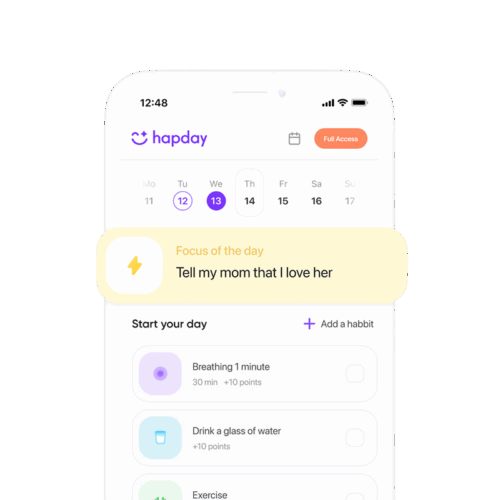
Need gentle, always-on support? Try Hapday AI Life Coach for 24/7 guided sessions, habit tracking, and personalized wellness programs: https://apps.apple.com/app/hapday-ai-life-coach/id1498572982
References
- American Psychological Association, Emotion Regulation — https://dictionary.apa.org/emotion-regulation
- American Psychological Association, Cognitive Reappraisal — https://dictionary.apa.org/cognitive-reappraisal
- American Psychological Association, Implementation Intention — https://dictionary.apa.org/implementation-intention
- Harvard Health Publishing, Breathing for calm — https://www.health.harvard.edu/mind-and-mood/breathing-for-calm
- Harvard Health Publishing, Sleep and mental health — https://www.health.harvard.edu/newsletter_article/sleep-and-mental-health
- Harvard Health Publishing, The health benefits of strong relationships — https://www.health.harvard.edu/newsletter_article/the-health-benefits-of-strong-relationships
- Harvard Health Publishing, Giving thanks can make you happier — https://www.harvard.edu/healthbeat/giving-thanks-can-make-you-happier
- CDC, Benefits of Physical Activity — https://www.cdc.gov/physicalactivity/basics/benefits-of-physical-activity.htm
- CDC, How Much Sleep Do I Need? — https://www.cdc.gov/sleep/about_sleep/how_much_sleep.html
- National Center for Complementary and Integrative Health, Relaxation Techniques — https://www.nccih.nih.gov/health/relaxation-techniques-what-you-need-to-know
- National Center for Complementary and Integrative Health, Mindfulness Meditation — https://www.nccih.nih.gov/health/mindfulness-meditation-what-you-need-to-know
- Mayo Clinic, Mindfulness exercises — https://www.mayoclinic.org/healthy-lifestyle/consumer-health/in-depth/mindfulness-exercises/art-20046356
Sources also consulted in drafting: Harvard Health Publishing; NCCIH; CDC; Mayo Clinic; interviews with licensed clinicians in New York and Boston during 2023–2024.
Join 1.5M+ people using Hapday’s AI-powered tools for better mental health, habits, and happiness. 90% of users report positive changes in 2 weeks.