


How to Find Inner Peace with Body Scan Meditation
You’re lying in bed, eyes open to the dark, replaying the day like a glitching reel. Your jaw is tight. Your shoulders creep toward your ears. There’s a storm inside your chest that no amount of scrolling can calm. This is usually where we reach for a fix. But the door to quiet may already be inside your body. That’s the promise of body scan meditation—an approachable, science-backed way to soften tension, meet your anxious mind with kindness, and find inner peace you can feel.
If you’re navigating stress, burnout, or low-grade anxiety that’s hard to name, body scan meditation offers a practical reset. It trains you to pay gentle attention to physical sensations from head to toe, without judging or trying to change them. By turning down mental noise and tuning into your body, you create space for relief, clarity, and a steadier nervous system. Most of us underestimate how physical our anxiety really is—most days it lives in muscle and breath, not just thought.
Table of Contents
- Why Body Scan Meditation Brings Inner Peace
- A Short Story of Change
- How to Practice Body Scan Meditation: A Gentle Walkthrough
- The Science Beneath the Softness
- Variations to Meet Your Life
- Troubleshooting Your Body Scan Meditation
- Body Scan Meditation for Anxiety and Stress Relief at Work
- What Progress Really Looks Like
- Making Body Scan Meditation Stick
- Everyday Rituals That Make Body Scan Meditation Part of You
- How Body Scan Meditation Plays with Other Tools
- A Note on Safety and Self-Trust
- The Bottom Line
- References
Key Takeaways
- Body scan meditation builds interoceptive awareness, helping you shift from mental rumination to grounded sensation.
- Regular practice supports the parasympathetic “rest-and-digest” response, easing stress, anxiety, and improving sleep.
- Even 5–10 minutes daily can create meaningful changes in focus, emotional regulation, and tension release.
- Adapt the practice to your needs—micro-scans, movement, or guided audio—consistency matters more than perfection.
- Go slowly, be kind, and tailor for safety; pause or get support if strong emotions or trauma responses arise.
Why Body Scan Meditation Brings Inner Peace
There’s a reason this practice anchors many mindfulness programs. Body scan meditation cultivates interoceptive awareness—your ability to notice signals from inside your body. When you can feel a clenched fist, a fluttering stomach, or warmth in your feet as neutral data—not good or bad—you begin to unhook from spirals of thought. Your body becomes a safe harbor, not a battleground.
“Think of it as mapping your inner weather. When you identify ‘tightness in the chest’ rather than ‘I’m failing,’ you move out of story and into sensation. That shift lowers the emotional charge and helps the mind settle.”
— Dr. Sarah Chen, Licensed Clinical Psychologist
This isn’t just poetic. The stress response speeds your heart rate, muscles, and thoughts when the brain detects a threat—real or imagined. Harvard Health Publishing notes that learning relaxation skills can counter this response and activate the body’s parasympathetic system, which slows breathing and heart rate and promotes calm. Mindfulness practices, including body scan meditation, have been shown to ease anxiety and mental stress in clinical settings. A 2014 review in JAMA Internal Medicine pointed in the same direction: mindfulness programs move the needle on anxiety and pain, modestly but meaningfully.
The NCCIH (NIH) likewise reports that mindfulness programs can help reduce stress, anxiety, and pain for many people, with a growing evidence base for these benefits. If you’ve been feeling wired and tired, you’re not alone. The CDC estimates about one in three U.S. adults doesn’t get enough sleep. By shifting attention out of mental rumination and into steady, neutral body sensations, body scan meditation can create a bridge to sleep and deeper rest—something many people notice even after a few sessions.
What makes this practice especially welcoming is that it doesn’t require perfect focus or special equipment. You can do it on your couch, in bed, or in a quiet corner at work—eyes open or closed. It meets you where you are.
A Short Story of Change
When Maya, 28, went through a painful breakup, her days were a loop of “what-ifs.” She tried journaling, long runs, even deleting social apps, but her mind kept roaring back. A therapist taught her a 10-minute body scan meditation to practice before bed. The first week was frustrating—her foot itched, her throat felt tight, and tears came. By week three, she noticed she was falling asleep faster.
“I’d feel the weight of my legs, the cool air on my cheeks,” she told me. “It didn’t fix the grief, but it gave me a place to put it. My body became a container big enough to hold everything.”
How to Practice Body Scan Meditation: A Gentle Walkthrough
Before the how, the why again: directing attention steadily along the body is like giving your mind a single, kind task. That task interrupts rumination loops and trains your attention to return, again and again, without scolding yourself. According to the Mayo Clinic, meditation practices can reduce stress and anxiety by encouraging a state of relaxation and enhancing emotional well-being. Body scan meditation is one of the most concrete, sensory ways to do this.
- Get comfortable. Lie down or sit upright with support. Let your hands rest naturally. If you like, place a blanket over your legs.
- Set a gentle intention. Something like, “For the next 10 minutes, I’ll be kind to my body, no matter what I notice.”
- Start at the crown of your head. Notice sensations: tingling, warmth, coolness, pressure, itch, pulsing, or even “nothing.” “Nothing” is still a valid sensation—note it without judgment.
- Move attention slowly. Forehead, eyes, jaw. Soften where you can, but don’t force anything. Then neck, shoulders, arms, hands. Chest, ribs, back. Belly, hips, thighs, knees. Calves, ankles, soles of the feet, toes.
- Breathe with each region. As you rest attention on an area, let one or two slow breaths wash through it. Imagine your inhale gathering sensation, your exhale releasing gripping.
- Label lightly. Use simple mental notes like “warm,” “tight,” “soft,” or “numb.” Keep it factual, not evaluative.
- When the mind wanders, it’s okay. Gently return to the body part you were on. That return is the practice.
- End wide. After you reach the toes, sense your body as a whole—like a single field of aliveness—while taking three easy breaths.
“Go slower than you think you need to. When you linger—really linger—on the shoulders, the belly, the soles of the feet, the nervous system gets the memo that it’s safe to power down.”
— Jason Reed, MBSR-Certified Mindfulness Teacher

The Science Beneath the Softness
Here’s what’s quietly happening as you practice:
- Attention training: You exercise neural circuits involved in focus and meta-awareness, which helps you notice when you’re lost in thought and return with less drama. The American Psychological Association highlights mindfulness meditation’s role in reducing stress and improving emotional regulation.
- Interoception and emotion regulation: Sensations are the building blocks of emotion. By feeling them precisely, you update the brain’s predictions and prevent old fear pathways from hijacking your day.
- Relaxation response: Slow, steady attention paired with relaxed breathing supports a parasympathetic tilt—heart rate eases, breath deepens, muscles unclench—countering the stress response described by Harvard Health.
“Body scan meditation is compassionate exposure. You approach your inner world in tolerable doses, which helps decondition the reflex to tense up or push sensations away.”
— Dr. Lena Ortiz, Health Psychologist
Variations to Meet Your Life
- Micro-scans (1–3 minutes): Waiting for coffee? Sweep awareness from head to toe on three slow breaths. Tiny resets throughout the day compound.
- Anchor-and-scan: If you’re anxious, keep about 30% of attention on the breath while you scan the body with the other 70%. A dual anchor often steadies racing thoughts.
- Waking and bedtime rituals: Before getting out of bed, scan from feet to head to check in. At night, scan down the body to invite sleep. A soothing ritual can help with widespread sleep insufficiency.
- Movement scan: On a walk, place attention in your feet—heel, arch, toes—then calves, knees, hips. Let each step be a metronome for presence.
- Guided support: If silence feels daunting, use a guided body scan meditation from a reputable app or teacher. Many find a warm voice cues relaxation faster than practicing alone.
Troubleshooting Your Body Scan Meditation
- “I feel nothing.” Numbness is a sensation. Get curious about its borders, temperature, or weight. Sometimes attention needs time to thaw.
- “I get restless or bored.” Normalize it. Shorten the session to 5 minutes and slow your breath. The goal isn’t to be zen; it’s to return, kindly, when you drift.
- “Strong emotions come up.” If overwhelm spikes, open your eyes, look around, and orient to safety. Place a hand on your chest or thigh and name what you see aloud. You can always stop. If trauma is part of your history, consider working with a trauma-informed therapist who understands mindfulness.
- “I fall asleep.” If it’s night, wonderful—let it be a glide into rest. If it’s daytime, try a seated posture or a cooler room.
It’s okay to adjust. You’re not failing the practice by taking care of your nervous system.
Body Scan Meditation for Anxiety and Stress Relief at Work
- At your desk: Place feet flat on the floor. Feel contact with the ground. Scan calves, thighs, sit bones. Drop your shoulders. Unclench your jaw. Exhale longer than you inhale.
- Between meetings: Stand up. Brush awareness down your arms and shake out your hands gently. Slide attention across your collarbones and belly, like dimming a screen’s brightness.
- After a tough email: Close your eyes for three breaths. Name sensations in the chest—tight, warm, flutter. Feel both feet. Choose one friendly action next, not five.
“This is nervous system hygiene. Just like washing your face, body scan meditation rinses off stress residue so you don’t carry every meeting, comment, or headline in your tissues.”
— Jason Reed, MBSR-Certified Mindfulness Teacher
What Progress Really Looks Like
- You catch tension earlier—shoulders rising, jaw bracing—and soften in real time.
- You react a beat slower, choosing a response instead of snapping.
- Sleep comes a bit easier, or you wake feeling less clenched.
- Pain feels more workable. You still feel it, but panic loosens.
Jordan, 33, a product designer, used to wake at 3 a.m. “doom-solving.” He started a 12-minute body scan most nights. “At first, I hated it,” he admits. “But around week four, I noticed I wasn’t reaching for my phone when I woke. I’d just feel my back against the mattress and my feet. It was boring—in a good way. Boring became peaceful.”
Making Body Scan Meditation Stick
- Consistency over intensity. Five minutes daily beats 30 minutes once a week.
- Pair with cues. After you brush your teeth or close your laptop, do a mini-scan.
- Track how you feel. A quick line in a notes app: “Scan: jaw softer, mind 6/10 busy.” Evidence of benefit fuels motivation.
- Community. Invite a friend to try a guided meditation with you once a week. Shared accountability helps, especially on hard days.
Everyday Rituals That Make Body Scan Meditation Part of You
- Tea ritual: While your tea steeps, scan from crown to toes. Sip while resting attention in your belly. Name “warmth” with each swallow.
- Commute reset: At a red light, find your sit bones, then feel your hands on the wheel. Exhale longer. Anxiety doesn’t drive you; you do.
- Shower grounding: As water hits each body part, attend to that area. Let the shower be a live guided body scan.
How Body Scan Meditation Plays with Other Tools
- Breathwork: Try slower exhales (for example, inhale 4, exhale 6) before your scan to ease into parasympathetic mode. Harvard Health discusses breath control as a way to settle the stress response.
- Journaling: After scanning, write three sensations and one emotion you noticed. Patterns and triggers become clearer.
- Movement: Gentle yoga or stretching followed by a body scan often deepens body awareness and stress relief.
A Note on Safety and Self-Trust
If you notice intense discomfort, trauma memories, or panic during body scan meditation, pause. Open your eyes, look around, feel your feet, and name five objects you see. Not everyone’s nervous system responds the same way to inward attention. It’s wise to tailor the practice or work with a clinician who understands mindfulness. The goal is inner peace, not pushing through pain. Trauma-sensitive mindfulness isn’t optional; it’s care.
“Inner peace isn’t the absence of sensation or thought. It’s the capacity to be with what’s here—a tingling calf, a tight jaw, a soft belly—without turning away. That capacity is trainable. Ten minutes at a time.”
— Dr. Sarah Chen, Licensed Clinical Psychologist
The Bottom Line
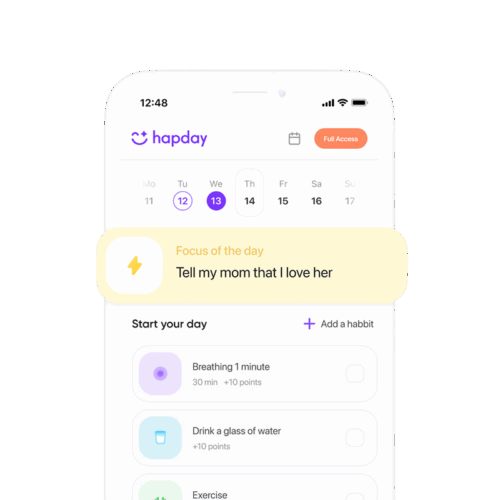
Body scan meditation is a simple, kind practice that helps you come home to your body, steady your nervous system, and soften mental noise—one breath at a time. Start small, go slow, and let it be imperfect. If you want steady guidance and motivation, try Hapday AI Life Coach for 24/7 guided sessions, habit tracking, and personalized wellness programs: Download here.
References
- Harvard Health Publishing – Understanding the stress response
- Harvard Health Publishing – Mindfulness meditation may ease anxiety, mental stress
- NCCIH (NIH) – Meditation and Mindfulness: What You Need To Know
- Mayo Clinic – Meditation: A simple, fast way to reduce stress
- American Psychological Association – Mindfulness Meditation
- Centers for Disease Control and Prevention – Sleep and Sleep Disorders: Data and Statistics
Join 1.5M+ people using Hapday’s AI-powered tools for better mental health, habits, and happiness. 90% of users report positive changes in 2 weeks.