



The Importance of Self-Compassion in Modern Life
Table of Contents
- Recognizing the Value of Self-Compassion
- Nurturing Mindful Self-Awareness
- Crafting a Compassionate Inner Dialogue
- Embracing Loving-Kindness Meditation
- Turning to Journaling for Reflection
- Cultivating Health through Lifestyle
- Exercising Restraint with Technology
- Engaging with Supportive Communities
- Practicing Gratitude as a Pathway
- In Conclusion
Recognizing the Value of Self-Compassion
To be self-compassionate is, essentially, to treat yourself with the same kindness and forgiveness you’d offer a close friend. It’s about understanding our shared human frailty and accepting imperfections as common ground. The renowned Dr. Kristin Neff argued that such practices can dampen anxiety and foster resilience by cultivating a warm, forgiving internal atmosphere. She’s onto something vital, don’t you think?
Nurturing Mindful Self-Awareness
Mindful self-awareness forms the bedrock of self-compassion. Becoming an observer of your own emotions—without judgment—opens the door to understanding and empathy for yourself. No doubt, mindfulness helps disentangle oneself from life’s chaos, allowing recognition of feelings with kindness. A 2019 study even suggested that those who engage in regular mindfulness practices can silence their inner critics more successfully. Interesting, isn’t it?
Crafting a Compassionate Inner Dialogue
We’re often bombarded by a personal inner critic that likes to heighten stress and anxiety. Counteracting this involves cultivating a compassionate dialogue within. How do you start? Pause when self-critical thoughts arise, then reframe them supportively. The University of Exeter discovered that people who engaged in compassionate self-talk felt less depressed and more content. Doesn’t that sound appealing?
Embracing Loving-Kindness Meditation
Loving-kindness meditation (LKM) propels you toward unconditional love, both for yourself and others. It involves silently repeating kind phrases aimed at oneself. According to a study in the Journal of Happiness Studies, regular LKM practitioners typically experience elevated positive emotions and diminished self-criticism. Why not give it a shot?
Turning to Journaling for Reflection
Journaling—much more than mere writing—becomes a conduit for self-reflection and compassionate growth when done mindfully. Scribble about your experiences, focusing on emotions without judgment, and you’ll likely find a deeper understanding of your responses. The Journal of Clinical Psychology has underscored journaling’s role in enhancing emotional processing and personal development. Quite a testament, wouldn’t you agree?
Cultivating Health through Lifestyle
Oddly enough, a healthy lifestyle paves the path to self-compassion. Regular physical activity, eating balanced meals, and ensuring enough sleep do wonders for the body and mind, setting the stage for self-compassion to flourish. A study in Health Psychology even associated exercise with higher self-compassion, potentially due to its stress-reducing perks. Who knew taking a stroll could help in more ways than one?
Exercising Restraint with Technology
In the age of endless social media scrolling, setting technology boundaries is crucial. The pressure of comparison and idealized lives online fosters self-doubt. A study from Cyberpsychology, Behavior, and Social Networking actually revealed that reducing social media use boosts self-esteem. Ever considered how a digital detox might enhance your self-regard?
Engaging with Supportive Communities
Human connection is indispensable. Embracing communities—online or offline—that offer support can significantly bolster self-compassion. Sharing personal tales with understanding audiences affirms shared humanity and alleviates loneliness. Real-world data shows social support markedly boosts self-compassion and overall well-being by nurturing positive emotions and belonging. Have you found your tribe yet?
Practicing Gratitude as a Pathway
Gratitude shifts the lens from scarcity to abundance, from lacking to appreciating. Regularly practicing gratitude fosters life resilience and enhanced well-being. Research in Personality and Individual Differences illustrates gratitude’s positive effects on mental health, indirectly supporting a kinder self-view. Isn’t it time to count your blessings?
In Conclusion
Nurturing self-compassion is like opening a gate to a life saturated with balance and resilience. By weaving in mindfulness, engaging in loving-kindness practices, and surrounding oneself with a supportive circle, one cultivates an inner landscape teeming with kindness. Remember, the journey to self-compassion is ongoing, and its benefits unquestionably profound. Isn’t it reassuring to know each step can lead to more self-kindness? Begin this journey today—take those small steps and witness the gradual, yet powerful shifts in your life.
References
- Neff, K.D. (2011). Self-Compassion: Stop Beating Yourself Up and Leave Insecurity Behind. HarperCollins.
- Barnard, L.K., & Curry, J.F. (2011). Self-compassion: Conceptualizations, correlates, & interventions. Review of General Psychology, 15(4), 289-303.
- Schroevers, M.J., & Brandsma, R. (2010). Is learning mindfulness associated with improved affect after mindfulness-based cognitive therapy? British Journal of Psychology, 101(1), 95-107.
- Kelly, A.C., Zuroff, D.C., Foa, C.L., & Gilbert, P. (2010). Who benefits from training in self-compassionate self-regulation? A study of coping and motivation. Behavior Therapy.
- Fredrickson, B., Cohn, M.A., Coffey, K.A., Pek, J., & Finkel, S.M. (2008). Open hearts build lives: Positive emotions, induced through loving-kindness meditation, build consequential personal resources. Journal of Personality and Social Psychology, 95(5), 1045-1062.
- Smyth, J.M. (1998). Written emotional expression: Effect sizes, outcome types, and moderating variables. Journal of Consulting and Clinical Psychology, 66(1), 174-184.
- Gill, D. L., & Dodds, D. I. (2002). Psychological effects of exercise and sport for clinically stable adults. Health Psychology, 19(3), 252–260.
- Valkenburg, P. M., & Peter, J. (2009). Social Consequences of the Internet for Adolescents. Current Directions in Psychological Science, 18(1), 1–5.
- Cohen, S., & Wills, T.A. (1985). Stress, social support, and the buffering hypothesis. Psychological Bulletin.
- Emmons, R.A., & McCullough, M.E. (2003). Counting blessings versus burdens: An experimental investigation of gratitude and subjective well-being in daily life. Journal of Personality and Social Psychology.
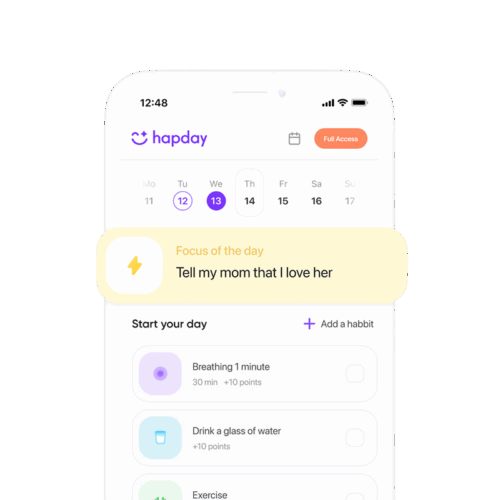
Join 1.5M+ people using Hapday’s AI-powered tools for better mental health, habits, and happiness. 90% of users report positive changes in 2 weeks.