



7 Ways to Journal Gratitude: Emotional Wellbeing Tips
It often begins after an ordinary bad day: sink full of plates, inbox stacked, brain lit up when the body is done. That’s where my own practice started—perched on the edge of the bed with a soft, beat-up notebook and a dull pencil—naming three small things I could honestly thank. Some nights it was “hot water,” “a text from Rina,” “the plant that didn’t die.” Not a cure, no; but the way the day settled in my chest changed. If you’re riding out burnout, anxious loops, or that low-grade hum of “not enough,” learning to journal gratitude can feel like a quiet exhale you can repeat—on demand, without performance.
What the research says helps is both plain and encouraging. Harvard Health has reported for years that people who keep up a gratitude habit tend to be more optimistic, feel better about life, and sleep more soundly. The APA links gratitude to stronger relationships and sturdier psychological well-being. And there’s the writing itself—NIH News in Health noted back in 2011 that expressive writing can lighten mood and lower stress-related symptoms. My take, after covering this beat for 15 years: the marriage of attention training and putting words to experience is unusually potent.
“Your brain is designed to scan for threat. Gratitude gently interrupts that scan. When you journal gratitude, you train attention toward safety, support, and sufficiency—even if it’s just for a few minutes a day.”
— Dr. Sarah Chen, Clinical Psychologist
In 2020, as lockdowns stretched on, The Guardian reported a spike in loneliness; practices like this were one small countercurrent people could actually control.
Below, seven grounded, research-informed ways to journal gratitude. Read them the way you’d read a note from a friend on a hard Tuesday. Try one or two, let them breathe, then add more if it fits. You don’t need perfection, only a little persistence.
Table of Contents
- Why journaling gratitude changes your nervous system
- 1) The “Three Good Things” reset
- 2) Micro-moment spotting throughout the day
- 3) A five-senses gratitude scan
- 4) The gratitude letter (and what comes after)
- 5) Self-directed gratitude: what you did right today
- 6) The “throughline” practice for tough days
- 7) Sleep-soothing gratitude ritual
- Gratitude journal prompts to lean on when you feel blank
- How to make the habit actually stick
- The deeper science thread you can trust
- A quiet permission to go slow
- Summary + CTA
- The Bottom Line
- References
Key Takeaways
- Gratitude journaling trains attention toward safety, support, and sufficiency, easing stress and anxiety.
- Short, consistent practices (like “Three Good Things”) boost mood, sleep, and relationship quality.
- Blending mindfulness with gratitude grounds the body while reframing thoughts.
- On hard days, focus on throughlines—what carried you—rather than silver linings.
- Momentum over perfection: one sincere line can be enough to keep the habit alive.
Why journaling gratitude changes your nervous system
Before the how, a short why. The CDC emphasizes stress-buffering skills—from staying connected to simple daily routines that cue calm. Gratitude can be one of those rituals. It signals your parasympathetic system—the rest-and-digest branch—that something here is safe enough to savor. And because writing makes emotion legible, it often loosens the mental knots you’ve been tugging all day. I’ve seen it help clients unclench their evenings in less than a week.
“When you journal gratitude, you pair cognitive reappraisal—finding a different frame—with a somatic downshift. Over time, the practice becomes a shortcut back to steadiness.”
— Dr. Luis Romero, Psychiatrist
That’s not magical thinking; it’s training.
1) The “Three Good Things” reset
Why it works: This classic trains your attention away from the negativity bias toward what was neutral-to-good. It’s brisk, repeatable, and it builds a back-catalog of ordinary steadiness you can return to on bleak days. Harvard Health once highlighted a six-week exercise where people who listed blessings felt happier than those who logged hassles. I’ve found this is the most honest entry point for skeptics.
How to journal gratitude this way:
- Each night, list three good things from the past 24 hours.
- Add one sentence on why each thing happened or why it mattered.
- Keep it boring-brilliant: “socks from the dryer,” “sun on the bus seat,” “roommate washed the pans.”
When Maya, 28, moved through a divorce, she used this format. “The days felt gray,” she told me. “When I forced myself to write down tiny moments, I realized the good wasn’t gone; it was just quieter than the pain.” I think she’s right—quiet is not the same as absent.
2) Micro-moment spotting throughout the day
Why it works: Gratitude expands when you catch it live, not only in the rearview. This turns the practice from a nighttime task into a daytime lens. The APA has long noted that gratitude strengthens social bonds; noticing micro-kindnesses in the moment makes you more likely to respond warmly, which then feeds connection. In 2021, UC Berkeley’s Greater Good Science Center echoed a similar pattern: what we notice, we intensify.
How to journal gratitude this way:
- Keep a small notes app or pocket notebook.
- Capture one-liners during the day: “barista remembered my name,” “neighbor held the elevator,” “song matched my mood.”
- At night, copy them into your main journal with a brief reflection on how your body felt in each moment.
Opinion, lightly stated: This is the least fancy method and, arguably, the most transformative over a month.
3) A five-senses gratitude scan
Why it works: Anchoring in the senses is a mindfulness staple—present, specific, nonjudgmental. NCCIH defines mindfulness along those lines and ties it to better mental well-being. Pair it with gratitude and you nudge presence toward appreciation rather than analysis. When I do this after reporting late at night, my shoulders drop a half-inch. It’s subtle. It’s enough.
How to journal gratitude this way:
- Write five short lines labeled Sight, Sound, Smell, Touch, Taste.
- Fill in one thing you appreciated for each sense from the last day.
- Add a note: What changed in your breathing or shoulders as you wrote? This helps you track physiological cues of calm.
One editorial note from experience: specificity beats poetry here.
4) The gratitude letter (and what comes after)
Why it works: Naming what someone gave you—clearly, concretely—strengthens relationships, which buffer stress and loneliness. The APA links gratitude with healthier social functioning and relationship quality. Whether you send the letter or not, writing it tends to surface feeling. Sometimes more than you expect.
How to journal gratitude this way:
- Choose someone who helped you—directly or indirectly—this month or years ago.
- Handwrite a one-page letter about what they did and how it affected your life.
- If appropriate, share it. If not, keep it private.
- Then, journal gratitude about the experience of writing the letter: What came up? What softened? What do you want to remember about the person—and about yourself—in this memory?
When Theo, 31, wrote to his high school art teacher, he didn’t expect tears. “I thought it would be cheesy,” he said. “But as I wrote afterward, I realized I’d been carrying the belief that I only had value when I achieved. Her class was the first place I felt seen.” My bias: we underestimate how hungry we are to say thank you out loud.
5) Self-directed gratitude: what you did right today
Why it works: Many of us thank everyone else and forget ourselves. Self-directed gratitude builds self-efficacy—the sense that your actions matter—which is tied to more resilient stress responses. Mayo Clinic has long encouraged reframing self-talk and naming strengths as an antidote to spirals. It’s not puffery; it’s balance.
How to journal gratitude this way:
- Title a page “What I did right today.”
- List 3–5 items, no matter how small: “replied to the hard email,” “drank water before coffee,” “said no kindly.”
- End with one sentence of appreciation to yourself, like you would to a friend.
“When you journal gratitude toward yourself, you interrupt a lifetime of internal criticism. You’re not inflating your ego—you’re balancing the ledger.”
— Dr. Aaliyah Ford, LMFT
I’d add: readers tell me this one feels awkward for a week, then quietly essential.
6) The “throughline” practice for tough days
Why it works: Some days reject silver linings. This approach honors that and still helps your mind mark threads of support. It’s not about minimizing pain; it’s about noticing what helped you move through it. The CDC repeatedly points people back to controllables and routines—this is one of them. On crisis days, I consider this nonnegotiable.
How to journal gratitude this way:
- Name the hard thing in one clear sentence. Example: “I felt panicked after the meeting.”
- Then write a throughline: three things that carried you through. Maybe “texted cousin,” “walked outside,” “watched a funny video.”
- Close with “One thing I can influence tomorrow,” grounding your practice in agency.
Jaz, 25, started this during a long job hunt. “I couldn’t be grateful for outcomes,” they said. “The throughline helped me notice I still had small footholds.” Sometimes footholds are the story.
7) Sleep-soothing gratitude ritual
Why it works: Gratitude can quiet pre-sleep rumination and prime the mind for rest. Harvard Health has pointed to better sleep among people who keep gratitude lists. Combine that with a simple wind-down and you’re sending a clear nighttime signal. I’d argue good sleep is the most underrated mental health intervention we have.
How to journal gratitude this way:
- Set a phone reminder 45 minutes before bed: “wind down + journal gratitude.”
- Lightly stretch, dim lights, make tea.
- Write three lines that begin with “I’m thankful I got to…”
- If a worry pops up, jot it on a separate “tomorrow list” so your brain doesn’t cling to it overnight.
Gratitude journal prompts to lean on when you feel blank
Some nights the page is too white and your brain too loud. A few prompts can nudge you into motion without force. Use what lands; leave the rest.
Try a few of these:
- Someone who made my day easier today was…
- A tiny comfort in my space I appreciate is…
- A part of my body I’m grateful is working for me is…
- A mistake that taught me something I value…
- A song, scent, or view that shifted my mood was…
- One challenge I survived before—and what that shows me about myself…
- A resource I can return to when I feel overwhelmed is…
Behind each prompt is a simple nudge: specificity counters vagueness (which fuels anxiety), naming support counters isolation, recalling competence counters helplessness. When you journal gratitude with prompts, you’re guiding attention rather than waiting for motivation to appear.
How to make the habit actually stick
- Stack it onto something you already do: After you brush your teeth, sit down to journal gratitude for three minutes.
- Lower the bar: On hard days, write one line. One is enough.
- Keep tools visible: Leave your notebook open with a pen on top where you sleep or make coffee.
- Cue your senses: A particular lamp or playlist can make the ritual feel inviting.
- Track the ripple: Once a week, scan prior entries and circle patterns. Seeing themes—names, places, practices—helps your brain expect good things again.
“Consistency beats intensity. I’d rather you journal gratitude for 90 seconds most nights than write a novel once a month.”
— Dr. Sarah Chen, Clinical Psychologist
The deeper science thread you can trust
- Gratitude is associated with increased happiness and fewer depressive symptoms; structured practices like lists and letters help, and several studies link it to better sleep and relationships (Harvard Health Publishing).
- Writing is therapeutic; expressive writing can improve mood and certain health indicators over time (NIH News in Health).
- Stress-coping routines—like journaling—act as protective factors for mental health (Centers for Disease Control and Prevention).
- Mindfulness supports emotional regulation; blending it with gratitude helps you notice and savor what’s here (National Center for Complementary and Integrative Health).
- Reframing unhelpful thoughts builds resilience. Gratitude is one effective form of this cognitive shift (Mayo Clinic).
- The APA underscores gratitude’s role in psychological well-being and social connection, which buffers stress across the lifespan (American Psychological Association).
A quiet permission to go slow
If you’re reading this while exhausted, let it land softly: you don’t have to become a different person to feel better. You only need a thin thread of willingness. Choose one approach and journal gratitude for a week. Circle any entry that feels alive in your body when you reread it. That’s your clue. Follow that warmth. If one method doesn’t fit, let it go. You’re not failing—you’re personalizing.
And if it’s hard to access anything good right now, try this gentle doorway: “Today, I’m grateful I showed up to this page.” Then notice your breath, the weight of your body, the support that’s already here. That, too, counts.
When you journal gratitude consistently, you’re doing more than listing nice things. You’re training attention, supporting your nervous system, and building a portable refuge you can carry into the busiest, messiest days. You may feel a little steadier. You may sleep a little easier. Over time, you might trust that—even in a noisy world—you can locate what’s kind, enough, and true.
Summary + CTA
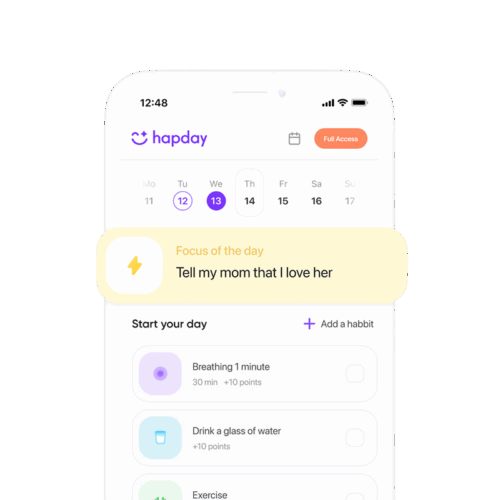
Gratitude is a small habit with outsize benefits. Pick one of these seven ways to journal gratitude, keep it imperfect, and let your attention relearn what’s steady and supportive in your life. If you want a steady nudge toward calmer routines, try a 24/7 coach in your pocket. Download Hapday AI Life Coach for personalized sessions, habit tracking, and gentle accountability: https://apps.apple.com/app/hapday-ai-life-coach/id1498572982
The Bottom Line
Gratitude journaling is simple, flexible, and evidence-aligned. Start small, stay specific, and let consistency—not perfection—do the heavy lifting. Over time, you’ll build a reliable pathway back to steadiness, connection, and better sleep.
References
Join 1.5M+ people using Hapday’s AI-powered tools for better mental health, habits, and happiness. 90% of users report positive changes in 2 weeks.