



How to Set Boundaries in Your Self-Care Daily Routine
Table of Contents
- Introduction
- Why Boundaries Belong in Self-Care
- How to Set Boundaries in Your Self-Care Daily Routine: A Gentle Framework
- How to Set Boundaries in Your Self-Care Daily Routine at Work
- Communication Skills That Make Boundaries Stick
- Build Boundaries Around These Core Self-Care Pillars
- Scripts You Can Borrow
- When Guilt Shows Up
- If This Sounds Familiar
- Evidence-Backed Tweaks That Boost Staying Power
- Troubleshooting: What if Someone Pushes Back?
- An Image to Hold
- A Weeklong Reset Plan You Can Actually Do
- 60-Second Summary
- Steady Support
- The Bottom Line
- Sources and Evidence That Guide These Practices
Key Takeaways
- Boundaries are essential for nervous-system regulation, not just productivity.
- Protecting sleep, taming technology, and scheduling recovery time are high-impact places to start.
- Use clear, kind language and visible calendar blocks so others respect your limits.
- Start tiny, repeat consistently, and repair quickly after inevitable wobbles.
- Predictability creates safety—small, steady routines compound into real change.
Introduction
Here’s a familiar picture: It’s late, and you’re curled into bed, eyes gritty, thumb hovering over one last email. You promised yourself earlier that tonight would be different—that you’d read, journal, breathe. But the draft won’t send itself, your group chat is buzzing, and your heart rate is already a little too fast. I’ve been there—more than once—watching the blue light slide across the ceiling and knowing I’m bargaining with tomorrow’s energy. This is the moment where the day can still turn toward ease, where choosing yourself—clearly, kindly—could change tomorrow. Learning how to set boundaries in your self-care daily routine isn’t just a productivity trick. It’s a nervous-system intervention, a permission slip, and a long-term investment in your mental health.
If you’ve been feeling strung thin, you’re not alone. In 2019 the World Health Organization formally recognized burnout as an occupational phenomenon tied to chronic workplace stress, and estimates suggest anxiety and depression cost the global economy about $1 trillion in lost productivity each year. Scientists have been blunt about where the toll lands: not just in your thoughts, but across sleep, digestion, immunity, mood—the American Psychological Association has pages on it. And one practical, sobering stat I return to in interviews: the CDC says one in three adults doesn’t get enough sleep. That deficit bleeds into mental health, cognition, emotional regulation. Boundaries aren’t a luxury; they’re a public-health behavior, backed by evidence and, frankly, by common sense.
Why Boundaries Belong in Self-Care
We often assume self-care means adding more—more green smoothies, more habits, more 5 a.m. challenges. But most readers I speak with aren’t under-cared for; they’re over-scheduled. The paradox sits there, quietly. Boundaries are the subtraction that lets your nervous system breathe. By creating edges—around time, attention, energy, and technology—you reduce input, soften the stress response, and give restorative practices room to take root.
“Think of boundaries as the container that keeps your care from spilling everywhere. Your brain loves predictability. When you hold a clear ‘start’ and ‘stop’ to your day, you’re sending a safety signal to the nervous system. That signal lowers the volume on fight-or-flight and makes space for rest-and-digest to show up.”
— Dr. Lena Ortiz, PsyD
The physiology tracks. Simple breathwork and relaxation techniques can downshift stress. Mindfulness-based practices show promise for anxiety, depression, and stress. The catch? These tools need space to live. Without boundaries, your meditation loses a nightly face-off with Slack pings or a cascade of headlines.
When Maya, 28, went through her divorce, mornings felt chaotic and nights dissolved into doomscrolling. She started with one boundary: no phone in the bedroom after 9:30 p.m., followed by ten quiet minutes of stretching and breathing before sleep. The first week was awkward. By week three, she was falling asleep earlier, waking clearer, and—her words—“less breakable.” I don’t believe in silver bullets; neither does she. But that line in the sand gave her a reliable path back to herself.
How to Set Boundaries in Your Self-Care Daily Routine: A Gentle Framework
Start with your body’s language
Why it works: Your nervous system is your boundary barometer. Clenched jaw, shallow breath, prickly irritability, a racing mind—these are signals that your window of tolerance is narrowing. Reduce input, then add small, soothing practices, and you broaden that window so decisions come from steadier ground.
- Choose a 2–5-minute “anchor” practice at predictable times: one slow breath break at lunch, one body scan after work, one cup of tea without screens.
- Try the 4-6 breath: inhale for 4, exhale for 6, ten cycles.
- Use an environmental cue as your reminder—the kettle, the commute home, the sound of your computer powering down.
Protect sleep like a habitat
Why it works: Sleep is the master reset for mood and cognition. Evening blue light suppresses melatonin and shifts circadian timing.
- Decide on a “digital sunset” 60 minutes before bed. Devices leave the bedroom.
- Give your pre-sleep routine a beginning: dim lights, warm shower, one page of a book. Keep it simple and the same.
- Use boundary language: “I stop all work by 9 p.m. and charge my phone outside the bedroom.”
Calendar as a container, not a tyrant
Why it works: Time-blocking turns good intentions into visible commitments. When your calendar reflects care, you’re more likely to honor it—and less likely to overbook against your better judgment.
- Block your anchors first: sleep window, meals, movement, therapy, or journaling. These are non-negotiable—not to be traded away for meetings.
- Add buffers: 5–10 minutes between calls for bathroom, breath, or a quick stretch.
- Say no with clarity: “I’m not available then; here are two times that work.”
Technology boundaries that actually hold
Why it works: Every app, email, and ping competes with your attention. Attention is energy; it’s also finite. Limiting digital input helps you reclaim presence for healing practices.
- Use Do Not Disturb for recurring windows (mornings, lunch, nights).
- Unsubscribe and remove three non-essential apps from your home screen.
- Create one “responding hour” daily. Outside it, your inbox is closed.
Create energy budgets, not just time budgets
Why it works: An empty afternoon can still find you depleted. Tracking what replenishes or drains you clarifies what to protect—and what to gently decline.
- Keep a one-week energy log. After each activity, rate +2 (energizing), 0 (neutral), or −2 (draining).
- Replace one −2 task a day with a +2 micro-practice: sunlight walk, music, stretching, breathwork.
- Use your log to set limits: “I take only two social plans on weeknights.”
“Boundaries are less about rigid rules and more about rhythm. When you match your self-care to your body’s natural cycles—like morning clarity for journaling or evening wind-down for breath—you reduce friction. The easier you make it, the more likely it sticks.”
— Dr. Ravi Patel, MD
How to Set Boundaries in Your Self-Care Daily Routine at Work
The workplace is often where self-care goes to die—buried under meetings, constant pings, and invisible expectations. Yet this is precisely where boundaries matter. In 2022, the WHO and ILO urged concrete measures to protect mental health at work, pointing to staggering productivity losses linked to anxiety and depression. Your smaller lines here ripple outward—to your team, to your evenings.
- Meeting-free recovery windows: One 25-minute slot after deep work for a walk or breathing. Protect it with a recurring block.
- Email cadence: “I check email at 10 a.m. and 3 p.m.” Put it in your signature or team norms.
- Focus norms: Headphones on = deep work; cameras off for note-taking to reduce fatigue; 50-minute meetings instead of 60.
- Micro-rituals: Two minutes of box breathing before presentations; one minute of shoulder rolls between calls.
When Liam, 32, a startup lead, started booking daily “systems checks” from 12:30–12:45 p.m., he didn’t expect much. He stood up, drank water, did 20 squats, and took eight slow breaths. Within a month, his afternoon crashes eased, and he was more patient with his team. He describes it as “getting my brain back.”
Communication Skills That Make Boundaries Stick
Saying no without burning bridges
Why it works: Boundaries falter when they’re vague. Clear, kind language reduces friction and protects relationships; it also lowers your own anticipatory anxiety.
- Use “I” statements. “I can’t take this on this week” lands better than “You’re asking too much.”
- Offer what you can do. “I’m free next Tuesday” or “I can review two slides, not the full deck.”
- Script your default: “Thanks for thinking of me. I’m at capacity right now and need to honor my schedule.”
Making your care visible
Why it works: People tend to respect what they can see. When your calendar shows self-care blocks, others learn to work around them—no drama required.
- Label blocks specifically: “Therapy,” “Run,” “Stretch + Breath,” “Meal.” You don’t owe details, but specificity helps.
- Share team norms once: “I log off by 6 p.m. I’m offline Sundays.” Repeat as needed, without apology.
Repairing after a wobble
Why it works: Boundaries aren’t all-or-nothing. When you slip, repair builds trust with yourself. I’d argue repair is a more powerful muscle than resolve.
- Review, don’t ruminate. What triggered the wobble? What’s one tweak to prevent it?
- Reset today, not Monday. Re-commit to your next anchor practice.
“Think of boundaries as promises to your future self. Each time you keep one, you build self-trust. And with self-trust, guilt loses its grip.”
— Dr. Sarah Chen, Clinical Psychologist
Build Boundaries Around These Core Self-Care Pillars
Sleep
- Evidence anchor: One in three adults doesn’t get enough sleep. Protect a consistent bedtime and wake time, and dim screens earlier—blue light disrupts circadian rhythms.
Movement
- Evidence anchor: Aim for 150–300 minutes of moderate-intensity aerobic activity weekly. Movement enhances mood, sleep, and resilience.
Mindfulness and relaxation
- Evidence anchor: Mindfulness and relaxation techniques can help with stress, anxiety, and mood. Keep it bite-sized but consistent.
Nutrition and hydration
- Evidence anchor: Regular meals stabilize blood sugar and mood. Build buffers around lunch so you aren’t eating at your keyboard every day.
Social connection—and solitude
- Evidence anchor: Strong social support is linked to better health outcomes. Your boundary might be two unplugged dinners a week or a protected solo walk.
Digital hygiene
- Evidence anchor: Reduced evening screen exposure supports sleep; blue light suppresses melatonin.
Scripts You Can Borrow
For work
- “I’m protecting a deep-work block from 10–12; I can review this at 1 p.m.”
- “I’m not available after 6 p.m. I’ll pick this up in the morning.”
- “I can help for 20 minutes today, not the whole task.”
For friends and family
- “I’m taking quiet time tonight. Rain check this weekend?”
- “I’m offline Sundays. Text me Monday and I’ll respond then.”
- “I want to give you my full attention; can we talk after I finish my workout?”
For yourself
- “Phone stays out of the bedroom.”
- “No new commitments without a 24-hour pause.”
- “One screen-free meal a day.”
When Guilt Shows Up
Guilt is the mind’s way of testing new edges. It doesn’t mean you’re doing something wrong; it means you’re doing something new. Remind yourself: boundaries are a kindness that allows you to show up with more presence later. Screen time spiked for many of us; of course guilt followed when we pulled back—it often does.
Try this quick reset:
- Name the guilt. “I feel guilty for not replying at 10 p.m.”
- Name your value. “I value sleep and clear mornings.”
- Name your choice. “I’m choosing to respond at 8 a.m. to honor my health.”
If This Sounds Familiar
You say yes and resent it later. Your mornings start with chaos and coffee, your nights end with scrolling, and your body feels like a pulled thread. Start tiny. Choose one boundary to practice for two weeks. The goal isn’t perfection; it’s pattern.
Evidence-Backed Tweaks That Boost Staying Power
- Pair a boundary with a cue and a reward. Example: After I brush my teeth (cue), I put my phone in the kitchen (boundary), and turn on a lamp and open a book I actually enjoy (reward).
- Use public commitments sparingly. Tell one supportive person about your “digital sunset.” Social support helps habits stick.
- Make it frictionless. Put a physical book on your pillow. Leave a yoga mat by your desk. Set Do Not Disturb to turn on automatically.
- Track tiny wins. A simple checkmark for “breath, moved, slept, nourished” restores momentum.
Troubleshooting: What if Someone Pushes Back?
- Stay with your line, not your defense. “I’m not available after 6 p.m.” Full stop. You don’t have to justify.
- Offer alternatives. “I can meet at 4 p.m. tomorrow or 11 a.m. Thursday.”
- Don’t negotiate with your health. If your boundary is a medical or mental health necessity—therapy, medication schedule, sleep—treat it like any other appointment you’d never miss.
An Image to Hold
Sunlight on a quiet kitchen table—mug of tea steaming, phone on a charger across the room, an open paperback, and a small notepad with two checked boxes. Alt text: How to Set Boundaries in Your Self-Care Daily Routine
A Weeklong Reset Plan You Can Actually Do
- Day 1: Choose one anchor practice (2–5 minutes) and one digital boundary (e.g., Do Not Disturb 10 p.m.–7 a.m.).
- Day 2: Block sleep and one movement window on your calendar.
- Day 3: Delete three distracting apps from the home screen; unsubscribe from five emails.
- Day 4: Script your “no” and “capacity” phrases; practice one in a low-stakes moment.
- Day 5: Add a 10-minute midday walk or stretch; mark it as a recurring event.
- Day 6: Share your evening boundary with one person for accountability.
- Day 7: Review your energy log; swap one draining activity for a nourishing one next week.
Why this helps: Layering small, stable changes builds self-efficacy. You create a rhythm your body can predict, and predictability is profoundly regulating. Predictability is the quiet superpower of self-care—it’s not flashy, but it works.
60-Second Summary
When life gets loud, boundaries give your care a home. This guide shows how to set boundaries in your self-care daily routine with evidence-informed steps: protect sleep, use breath and mindfulness, treat your calendar as a container, and communicate limits with clarity. Start tiny, repeat gently, repair when you wobble, and let self-trust do the quiet work.
Steady Support
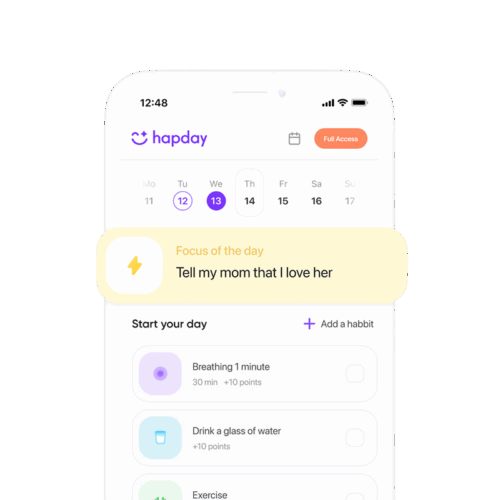
Want steady support? Try Hapday AI Life Coach for 24/7 guided sessions, habit tracking, and personalized wellness plans: https://apps.apple.com/app/hapday-ai-life-coach/id1498572982
The Bottom Line
Learning how to set boundaries in your self-care daily routine isn’t about becoming a different person. It’s about building a safer home inside your day so the person you already are can breathe. Let your boundaries be loving, imperfect, and alive. When tomorrow night comes and your thumb hovers over that last email, remember: you’re allowed to stop. You’re allowed to rest. And you’re allowed to redesign your life from that place. It’s your day—its edges are yours to draw.
Sources and Evidence That Guide These Practices
- World Health Organization — Burn-out an occupational phenomenon
- World Health Organization and ILO — Call for new measures to tackle mental health at work
- American Psychological Association — Stress effects on the body
- Centers for Disease Control and Prevention — 1 in 3 adults don’t get enough sleep
- Harvard Health Publishing — Blue light has a dark side
- Harvard Health Publishing — Relaxation techniques: Breath control helps quell errant stress response
- NCCIH — Mindfulness Meditation: What You Need To Know
- NCCIH — Relaxation Techniques for Health
- World Health Organization — Physical activity fact sheet
- NIH News in Health — Build social support for your health
Join 1.5M+ people using Hapday’s AI-powered tools for better mental health, habits, and happiness. 90% of users report positive changes in 2 weeks.