

Mindfulness for Beginners: Letting Go of Worry
Table of Contents
- What is Mindfulness?
- The Science of Letting Go
- Getting Started with Mindfulness
- Integrating Mindfulness into Daily Life
- Cultivating Patience and Compassion
- Conclusion
What is Mindfulness?
Life in the 21st century—chaotic, isn’t it? Work piles up, family obligations tug at your sleeve, and worry… well, it clings to you like a shadow. Mindfulness emerges as a reliable ally, though, guiding you through these tangles with a promise of peace. It’s not about vanquishing stress but about sidestepping it gracefully.
At its core, mindfulness is both ancient and utterly now. It’s about being present, focused, non-judgmental. Sound easy? Perhaps in theory. Mindfulness, with its deep roots in meditation practices dating back centuries, encourages a transformation in how you view your mental space. Anxiety takes a back seat, replaced by a more nuanced emotional well-being.
Jon Kabat-Zinn, who arguably brought mindfulness to mainstream Western culture, describes it as paying attention purposefully and without judgment—here and now. Fascinatingly, according to findings in the Journal of Consulting and Clinical Psychology, practicing mindfulness can slice anxiety levels by around 30%, and stress by about 28%. But remember, numbers can never capture the whole picture, can they?
The Science of Letting Go
“Letting go” might conjure images of something slipping from your grasp, yet here, it’s more about embracing release. Neurologically, mindfulness calms that little troublemaker—the amygdala, our “fight or flight” machine—and instead lights up the prefrontal cortex, the rational hub of the brain. Regular mindfulness practices can rewire this brain, lessening its ruminative tendencies.
Harvard Medical School’s research supports this, noting a mere eight weeks of mindfulness meditation boosts gray matter density in regions linked to memory and emotional regulation. This reshaping aids in crafting a mental space where worry loses its sting.
Getting Started with Mindfulness
1. Mindful Breathing
Begin with the simplest of tasks: breathing. Focus wholly on your breath as it flows in and out. Inhale slowly… let every part of you expand, then exhale gently. Find your mind wandering? Just bring it back softly, without scolding yourself. This modest exercise, even for just five minutes daily, can fundamentally shift how you interact with stress.
2. Body Scan Meditation
Engage in a body scan—a meticulous journey through your physical form. Notice each sensation without altering them. Feeling tension in your shoulders? Just acknowledge it. This practice can often promote profound relaxation. A study from the Journal of Behavior Research and Therapy observed a 32% reduction in anxiety symptoms among those who practiced body scans.
3. Walking Meditation
Incorporate mindfulness into everyday acts like walking. Slow down. Pay attention to each footfall. The simple act of walking can root you deeply in the present—a solid antidote to worry. Who knew walking could be such a meditation in itself?
4. Loving-Kindness Meditation
Lastly, try loving-kindness meditation—send out waves of goodwill to yourself and others. This practice nurtures positive emotions and dwindles negative self-talk. The Journal of Happiness Studies reports significant boosts in happiness for those who practice loving-kindness. Isn’t that what we all seek at the end of the day?
Integrating Mindfulness into Daily Life
Mindfulness doesn’t solely belong to meditation mats. Let it seep into daily life. Savor each bite, truly listen during conversations, engage deeply rather than skim the surface—or worse, multitask mindlessly. Research from Carnegie Mellon shows that folks who integrate mindfulness into everyday routines experience not just less stress but richer emotional regulation.
Cultivating Patience and Compassion
Be patient with yourself. Cultivating mindfulness is not about overnight success but slow and steady unfolding. Recognize steps of progress, however small. Practice compassionate self-talk; the journey of releasing worry is worth every stumble and stride. In a world spinning fast, isn’t learning to pause and be kind to oneself a bold, even revolutionary act?
Conclusion
Mindfulness isn’t about eradicating worry—it invites you to coexist peacefully with it. Through mindful breathing, walking, and compassionate living, you create a place where fear finds little foothold. In this practice, being grounded becomes second nature, transforming everything from mundane tasks to life’s grand events.
Begin this journey now. As stress releases its grip, you’ll soon find yourself standing more resilient, ever grounded. And remember, mindfulness is not a race or a finale—it’s a gentle path paved with each and every mindful breath.
Ready to explore mindfulness and begin releasing worry? Take the first step with our guided meditation series. Find calm, clarity, and perhaps, a touch of joy today.
References:
- Kabat-Zinn, J. (1990). Full Catastrophe Living: Using the Wisdom of Your Body and Mind to Face Stress, Pain, and Illness. Delta.
- Hofmann, S. G., et al. (2010). “The Effect of Mindfulness-Based Therapy on Anxiety and Depression: A Meta-Analytic Review.” Journal of Consulting and Clinical Psychology.
- Desbordes, G., et al. (2012). “Changes in Gray Matter associated with Mindfulness Meditation.” Journal of Neuroscience Research.
- Arch, J. J., & Craske, M. G. (2006). “Mechanisms of Mindfulness: Emotion Regulation Following a Focused Breathing Induction.” Journal of Behavior Research and Therapy.
- Fredrickson, B. L., et al. (2008). “Open Hearts Build Lives: Positive Emotions, Induced Through Loving-Kindness Meditation, Build Consequential Personal Resources.” Journal of Happiness Studies.
- Creswell, J. D., et al. (2007). “Mindfulness meditation training effects on CD4+ T lymphocytes in HIV-1 infected adults: A small randomized controlled trial.” Brain, Behavior, and Immunity.
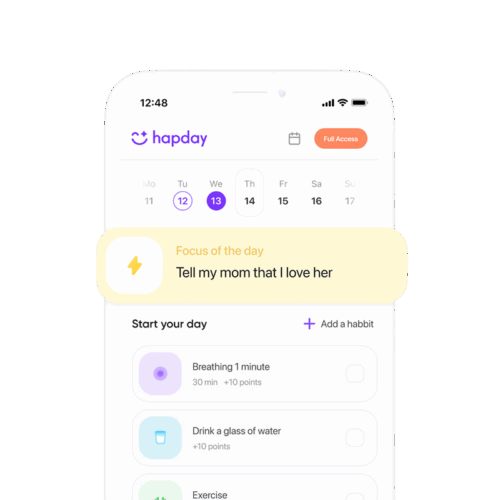
Join 1.5M+ people using Hapday’s AI-powered tools for better mental health, habits, and happiness. 90% of users report positive changes in 2 weeks.