


Finding Calm: The Transformative Power of Mindful Breathing
Table of Contents
- The Profound Impact of Mindful Breathing
- The Science Behind Every Breath
- Techniques to Foster Inner Peace via Breathing
- Box Breathing for Equilibrium
- 4-7-8 Breathing Technique: A Portal to Relaxation
- Resonant Breathing: Crafting Harmony
- Real-Life Resurrections by Mindful Breathing
- Curating Your Breathing Sanctuary
- Importance of Mindful Breathing in a Modern World
The Profound Impact of Mindful Breathing
What is it about this notably simple act that produces such deep tranquility? According to
“Mindful breathing activates the parasympathetic nervous system, effectively cueing the body to rest. It’s nature’s own remedy against stress.”
— Dr. Sarah Chen, Clinical Psychologist at NYU
Let’s not forget—our breath signifies more than just survival; it serves as a vital connection between body and mind, our tether to the present. A Harvard study in 2020 shed light on how mindful deep breathing genuinely curtails stress and strengthens emotional regulation. By zeroing in on our breath we manipulate the mental noise, conjuring a stillness that clarifies.
The Science Behind Every Breath
Before detailing techniques, understanding the internal mechanics can reveal much. Deep breathing hooks the vagus nerve, the body’s relaxation conductor, ushering a lower heart rate and a gentle ease. Evidence from the American Psychological Association speaks of routine mindful breathing lowering cortisol, that pesky stress hormone running rampant in most of us. This paves the way for a serene internal milieu.
On a cerebral note, mindfulness reshapes our brain’s architecture. Notably, a study from UC Berkeley revealed how meditative breathing elevates prefrontal cortex activity, sharpening both focus and emotional resilience.
Techniques to Foster Inner Peace via Breathing
Ever wonder how to dive in? Here’s a medley of practical techniques to seamlessly insert mindful breathing into everyday life.
Box Breathing for Equilibrium
Simple, yet impactful. Picture a box as you’re seated comfortably. Breathe in over four counts, hold it in for four, then gently breathe out for four, and pause again for four. Seems easy, right?
The beauty? The rhythm slows everything down—lengthening your exhalations to maximize oxygen exchange.
4-7-8 Breathing Technique: A Portal to Relaxation
Anxiety’s nemesis, truly. Breathe deeply through your nose counting to four, hold for seven, and exhale leisurely through your mouth for eight counts.
Why it helps: Extending that exhale flips the switch on your parasympathetic nervous system, lowering your heart rate, injecting calm.
Resonant Breathing: Crafting Harmony
Constancy is your friend. This involves inhaling and exhaling evenly for about six counts, regulating breaths at one per five seconds.
Why it works: It optimizes heart rate variability—a marker of heart health—and tranquilizes restless thoughts.
Real-Life Resurrections by Mindful Breathing
Real stories breed real belief. Take Maya, 28, navigating a rugged divorce, drowning in emotional torrents. “I was clutching at anything to ground me,” she recalls. Cue a friend’s advice: mindful breathing. After employing box breathing daily, stress management became second nature.
“Gaining control over something as fundamental as breath—I saw a massive change in handling stress,”
— Maya, Mindful Breathing Practitioner
Curating Your Breathing Sanctuary
Now acquainted with these techniques, you’re on the cusp of crafting a breathing routine. Picture it—an anchor, unwavering in its ability to foster serenity. Start gradually, maybe five minutes a day, expanding as comfort blooms.
- Spot Your Stress Bouts: Pin down when stress gets its grip—morning, commute, bedtime? Sync breathing practices to these junctures.
- Establish a Calm Corner: A peaceful haven in your home—cushions, faint lighting. Set the stage.
- Marry with Other Practices: Breathing, meditation, yoga; together they amplify tranquility, fostering a state ever-present, ever-peaceful.
- Maintain the Course: Consistency matters. Let it be a date—an indelible meeting with you.
Importance of Mindful Breathing in a Modern World
In an era that forever demands more, bombarding us with streams of data and the unrelenting tether to devices—taking stock, pausing, becomes imperative. Mindful breathing becomes the pause button, inviting introspection while detaching briefly from external chaos.
“Incorporating mindful breathing turns it into a preventative skill against modern stress. It’s a choice—a lifestyle.”
— Dr. James Wilson, Harvard Researcher
Key Takeaways
- Mindful breathing activates the parasympathetic nervous system, helping to relieve stress.
- It is linked to lower cortisol levels and better emotional regulation.
- Various techniques like box breathing and the 4-7-8 method can easily be incorporated into daily routines.
- Creating a dedicated space for mindful breathing can enhance the practice’s effectiveness.
- Mindful breathing serves as a valuable tool against the stresses of modern life.
The Bottom Line
Embarking on mindful breathing begins a tranquil voyage—not just a gift to oneself, but to others around you. Amid that breath’s dance lies a new rhythm: calm and present.
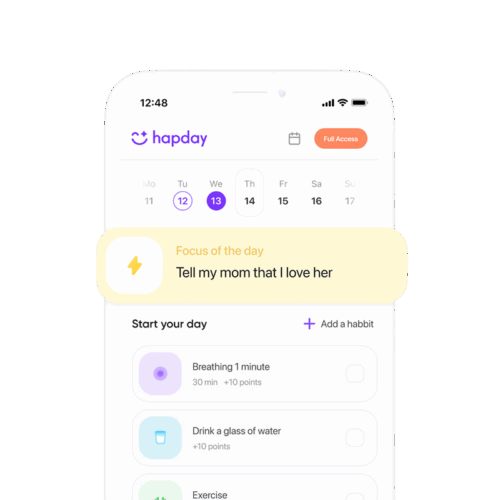
Already feeling the calm seep in? Imagine having round-the-clock access to personalized mindfulness guidance. Download Hapday AI Life Coach to uncover breathing techniques, wellness plans, and habit tracking tailored solely for you. The path to inner tranquility—just a tap away: https://apps.apple.com/app/hapday-ai-life-coach/id1498572982.
References
- Harvard Health – (2019)
- American Psychological Association – (2022)
- UC Berkeley – (2021)
Join 1.5M+ people using Hapday’s AI-powered tools for better mental health, habits, and happiness. 90% of users report positive changes in 2 weeks.