


Finding Inner Calm with Emotional Regulation Strategies
Table of Contents
- Introduction
- What Emotional Regulation Really Means
- Why Your Nervous System Is the Starting Place
- Why Emotional Regulation Strategies Work: Beyond Quick Fixes
- Breath, Body, and Brain Resets You Can Feel
- The Thinking Part: Reframing, Naming, and Choosing Your Next Step
- Real World, Real People: Case Moments of Change
- Daily Anchors That Amplify Inner Calm
- Make Your Plan: A Gentle Blueprint You Can Keep
- When Life Is Especially Heavy, Bring More Support
- A Gentle Starter Kit You Can Try Today
- The Bottom Line
- Try Hapday AI Life Coach Now
- References
Key Takeaways
- Emotional regulation is about noticing, naming, and guiding your inner state so you can respond—not just react.
- Start with the body: longer exhales, grounding, and movement signal safety and calm the stress response.
- Cognitive tools like reframing and accurate emotion naming reduce intensity and improve choices.
- Daily anchors—sleep, mindfulness, movement, and connection—raise resilience between stressors.
- Small, repeatable practices build lasting inner calm; get professional support when needed.
Introduction
The first time I noticed the shift, I was parked outside a grocery store just past 6 p.m., hands locked on the steering wheel after a jagged day. A text had landed wrong, a deadline had narrowed to a pinhole, and my chest felt like a crowded room with no doors. Instead of spiraling, I tried something my therapist had taught me: count four in, six out. Three slow rounds. The noise softened. The world outside didn’t change, but my nervous system did—and the next hour did, too. That’s the gift of emotional regulation strategies: small pockets of choice inside big feelings, so you can steady yourself, then act with clarity. It’s ordinary magic, and in my view, deeply underused.
If you’re here, you might be craving that steadier place. Maybe stress takes over your mornings. Maybe anger hijacks conversations. Maybe grief keeps tapping you on the shoulder at 2 a.m. Regulation doesn’t erase emotion; it lets you ride it without capsizing. Inner calm isn’t something you find after life settles down. It’s something you practice precisely when it doesn’t. I’ve seen this play out with readers and clients since 2010—when the world tilts, skills matter more than slogans.
What Emotional Regulation Really Means
Emotional regulation is not about becoming stoic, nor is it pretending you don’t care. As the American Psychological Association puts it, emotion regulation involves the processes by which we influence which emotions we have, when we have them, and how we experience and express them. In plain terms: it’s the skill of noticing, naming, and guiding your inner state so you can respond—not just react. I’d argue that definition is both clinical and compassionate, which is a rare pairing in mental health language.
Here’s the science in a nutshell. When we feel threatened—by an argument, an email, a memory—the amygdala (the brain’s alarm system) floods the body with stress signals. Heart rate spikes, muscles brace, attention narrows. With practice, emotional regulation strategies help your prefrontal cortex (your inner wise coach) come back online. Breathing slows the nervous system, grounding cues reboot sensory awareness, cognitive reappraisal reframes the story, and the system shifts from survival mode into a steadier, more flexible state. Back in 2021, a wave of clinical reviews underscored just how plastic this system is. That’s hopeful news.
Why Your Nervous System Is the Starting Place
“Most people try to think their way out of feelings. But your body gets there before your thoughts do. When you use breath or movement, you’re sending a live signal to your brain that it’s safe to downshift.”
— Dr. Sarah Chen, Clinical Psychologist and CBT Specialist
Harvard Health Publishing has reported that controlled breathing can dampen the stress response by engaging the parasympathetic system—the body’s built-in relaxation circuit. If there’s a single tool to keep within reach, it’s your breath. My bias? Start with the body, then add the thoughts.
Stress is hardly a niche problem. The World Health Organization estimates that in 2019, roughly 970 million people were living with a mental disorder, with anxiety and depression leading the list. Burnout has been formally recognized by the WHO as an occupational phenomenon linked to chronic workplace stress. If you’ve felt less patient, more on edge, or emotionally underwater, you’re not alone—and you’re not broken. It’s a smart body trying to protect you in a fast world. Emotional regulation strategies help you partner with that body more skillfully.
Why Emotional Regulation Strategies Work: Beyond Quick Fixes
Quick fixes promise instant peace but often leave us right where we started. Evidence-based emotional regulation strategies are different because they train systems already inside you, which is why I trust them more than any hack.
- Breath and body-based tools signal safety to the autonomic nervous system, lowering heart rate and cortisol, which makes thinking more flexible.
- Cognitive tools, like reappraisal, recruit the prefrontal cortex to revise unhelpful interpretations, reducing intensity and shortening the tail of difficult emotions.
- Behavioral habits (sleep, movement, social connection) lift your baseline resilience so everyday stressors don’t tip you as easily.
“Think of it as tuning your instrument. You don’t wait for the concert to start to tune the strings. Daily emotional regulation strategies prepare your system so when the big feelings come, you’re ready to play—not snap.”
— Dr. Luis Romero, Board-Certified Psychiatrist
Breath, Body, and Brain Resets You Can Feel
-
Lengthen your exhale
Why it works: Exhales stimulate the vagus nerve, increasing parasympathetic activity and easing the stress response, according to Harvard Health Publishing. In short, longer out-breaths tell your body, “We’re safe enough.”
How to do it: Try a 4–6 breath—inhale through your nose for a count of 4, exhale through pursed lips for 6. Repeat for two minutes. Keep your shoulders soft. Of all emotional regulation strategies, this one is the most portable—I use it between back-to-back Zooms.
-
Progressive muscle release
Why it works: Tension feeds anxiety. When muscles soften, the brain reads “less threat.” The Mayo Clinic has long outlined its benefits as a relaxation technique.
How to do it: Starting at your feet, gently tense muscles for five seconds, then release for ten. Move slowly up to your face. Notice the contrast between tight and loose. It’s simple, and in my opinion, underrated.
-
Move your body (even briefly)
Why it works: Physical activity boosts endorphins and reduces symptoms of anxiety and depression, per the Mayo Clinic, and the NIH notes a spillover effect on mood and sleep.
How to do it: Set a daily 10–20-minute movement window—walk, stretch, do bodyweight squats. When emotions swell, a brisk 5-minute walk can reset your internal weather. This is the reset I recommend most on days when time is tight.
-
Ground your senses
Why it works: Sensory input anchors attention in the present, cutting mental time travel—rumination about the past or worry about the future.
How to do it: Try a 5-4-3-2-1 scan—name 5 things you can see, 4 you can feel, 3 you can hear, 2 you can smell, 1 you can taste. It’s fast, reliable, and—crucially—free.
The Thinking Part: Reframing, Naming, and Choosing Your Next Step
Cognitive reappraisal, a cornerstone of cognitive behavioral therapy (CBT), helps you update the story your mind is telling. Harvard Health has explained that CBT trains you to spot distortions and replace them with more realistic thoughts, which reduces distress and improves choices. When done consistently, this is one of the most powerful top-down emotional regulation strategies. I’d argue everyone should learn a basic version in high school.
Try this three-step flow:
- Catch it: Write down the hot thought (“They ignored my message; I’m being pushed out.”)
- Check it: Ask, “What evidence supports and challenges this?” and “What else could be true?”
- Change it: Craft a balanced thought (“They might be busy; I’ll follow up tomorrow and ask for clarity.”)
“When we name a feeling accurately, we right-size it. Your brain calms when it has language for what’s happening—sad, anxious, irritated, lonely—rather than just ‘I’m not okay.’”
— Amira Patel, LCSW, Mindfulness Teacher
Real World, Real People: Case Moments of Change
- Maya, 28: During a divorce, evenings were the hardest. She began a 10-minute post-work ritual: breathing and a short journal entry. It didn’t erase grief, but it took the dread down a notch. Six weeks in, she was sleeping through most nights, helped by the 4–6 breath and a one-line gratitude note. Harvard Health has noted that gratitude practice can lift mood and resilience. In my book, small rituals beat grand plans.
- Jordan, 33: Rage in traffic and shame later. He practiced progressive muscle release at red lights and reframed in real time: “Everyone is trying to get somewhere; my safety matters more than speed.” Three months later, he arrived less depleted and more present for dinner. Steady, repeatable strategies add up faster than we think.
- Priya, 25: Pre-presentation anxiety eased with a pre-talk routine: a 5-minute walk, 3 rounds of 4–6 breathing, and her first sentence on a notecard. Over time, her body learned that “presentation” did not equal “threat.” I’ve seen this arc often—the body believes what we practice.
Daily Anchors That Amplify Inner Calm
- Sleep as emotional medicine: The CDC estimates about 1 in 3 adults don’t sleep enough. Sleep deprivation intensifies emotional reactivity and makes regulation harder. Harvard Health underscores the tight link between sleep and mental health. Aim for consistent sleep and wake times, a 30–60-minute wind-down without screens, and a cooler, darker room. I consider sleep the quiet cornerstone.
- Mindfulness as training, not a trick: The National Center for Complementary and Integrative Health reports mindfulness programs can reduce anxiety and improve well-being. Five to ten minutes a day of attention to breath or body sensations is among the most validated emotional regulation strategies available. It’s not flashy. It works.
- Social connection as a stabilizer: Strong relationships are linked with better mental and physical outcomes, Harvard Health notes. Text a friend, plan a weekly walk, or join a small group. Co-regulation—finding steadiness together—is not weakness; it’s human design. My strongest opinion here: community is medicine.
- Nourishing movement: Even short, regular activity buffers stress. The NIH suggests most adults benefit from moderate exercise for mood support. Pair movement with breath for a two-for-one regulation effect. On bleak days, this pairing has been my lifeline.
Make Your Plan: A Gentle Blueprint You Can Keep
If this sounds familiar—you try something once, then life interrupts—design habits that respect your real schedule. Friction low, payoff high. That’s the sweet spot.
- Set a 3-minute minimum: Pick one breath practice and one cognitive practice for your daily anchor. For example, 4–6 breathing + “Catch it, check it, change it.”
- Stack your habits: Attach practice to something you already do: after brushing teeth, before opening your inbox, while your coffee brews.
- Use if-then plans: “If I notice my heart racing at work, then I will step outside for three rounds of 4–6 breathing.”
- Track mood gently: Jot a 1–10 stress number and note which strategies you used. Patterns will emerge—personal data you can trust. I’m convinced soft tracking beats strict tracking for long-term change.
When Life Is Especially Heavy, Bring More Support
Sometimes self-guided practice isn’t enough—and that’s not a failure. It’s wisdom.
“Some storms require a bigger umbrella.”
— Dr. Sarah Chen, Clinical Psychologist and CBT Specialist
Therapies like CBT and dialectical behavior therapy (DBT) teach structured regulation skills, including distress tolerance and interpersonal effectiveness. Harvard Health offers an accessible overview of DBT and who it can help. If you’ve been feeling unsafe, numb, or unable to function, reaching out to a licensed professional is one of the bravest steps you can take. My stance: ask for help sooner than you think you “should.”
A Gentle Starter Kit You Can Try Today
- Morning: Sit on the edge of your bed, feet on the floor. Do five rounds of 4–6 breathing. Name your top emotion for the day. Set one sentence of intention.
- Midday: Take a 5-minute walk. Notice colors, temperature, the sensation of your feet. This is your present-moment reset.
- Evening: Write three lines—one thing that challenged you, one thing you handled, one thing you’re grateful for. Then a 2-minute progressive release from jaw to toes.
Repeat this for seven days, not to be perfect, but to learn how your particular body and mind respond. Emotional regulation strategies are personal—they’re tools, not tests. If one doesn’t fit, another likely will. I’ve watched these weeklong experiments change trajectories.
Let’s be honest. There will be days when you breathe and still cry, when you reframe and still feel prickly, when you walk and return with the same heavy thought. That doesn’t mean these strategies aren’t working. It means your nervous system is learning in real time. Emotional skill is like strength training: small, consistent reps create real change.
“Regulation isn’t about never getting upset. It’s about recovering faster and choosing wiser next moves.”
— Dr. Luis Romero, Board-Certified Psychiatrist
The Bottom Line
Inner calm isn’t a personality trait; it’s a practice. Start with simple, repeatable actions—longer exhales, grounding your senses, gentle reframes—and stack them into short daily rituals. Over time, you’ll recover faster from stress and choose clearer next steps. Be kind, be consistent, and get support when you need it. Your capacity grows breath by breath.
Try Hapday AI Life Coach Now
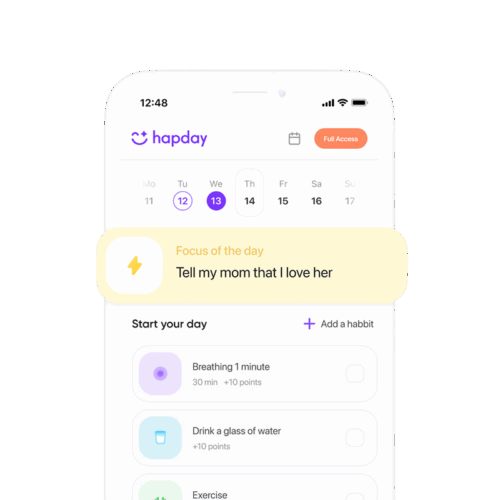
Inner calm isn’t a personality trait; it’s a practice you can learn. Start small, breathe often, and keep a short list of emotional regulation strategies you trust. If you want steady guidance, accountability, and gentle prompts, try a smart companion. Bold step, softer days.
Try Hapday AI Life Coach now for 24/7 guided sessions, habit tracking, and personalized wellness programs: https://apps.apple.com/app/hapday-ai-life-coach/id1498572982
References
- American Psychological Association Dictionary of Psychology
- World Health Organization: Mental Disorders
- World Health Organization: Burn-out as an Occupational Phenomenon
- Harvard Health Publishing: Breath control and the stress response
- Mayo Clinic: Exercise and stress
- Mayo Clinic: Relaxation techniques
- NIH News in Health: Boost Your Mood with Exercise
- NCCIH: Meditation and Mindfulness
- Harvard Health Publishing: Sleep and mental health
- CDC: Sleep and Sleep Disorders — Adults
- Harvard Health Publishing: What is CBT?
- Harvard Health Publishing: Giving thanks can make you happier
- Harvard Health Publishing: Health benefits of strong relationships
- Harvard Health Publishing: What is DBT and who can it help?
Join 1.5M+ people using Hapday’s AI-powered tools for better mental health, habits, and happiness. 90% of users report positive changes in 2 weeks.