


How to Find Inner Peace During Busy Days
The morning begins with a chorus of pings: emails at 6:12 a.m., a group chat at 6:15, calendar alerts stacking like dominoes. You pour coffee, skim headlines, and already feel behind. I counted 27 alerts before 7 a.m. one Tuesday in March—each insisting it was urgent. If this is your daily soundtrack, you’re not alone. The question pressing at the edges of your attention is the one you came here to ask: how to find inner peace during busy days when the day never stops moving?
Here’s the gentlest truth first: peace isn’t a mountain you climb once, it’s a pulse you return to—sometimes for 30 seconds at a time. And it’s not frivolous. It’s a health practice as real as sleep, water, or a brisk walk, with solid science behind why it steadies your body and mind. I’d argue it’s become basic hygiene.
Key Takeaways
- Inner peace is built in short, repeatable moments—think 30–60 seconds—woven through your day.
- Mindfulness, breathwork, brief movement, and nature glances calm the nervous system quickly.
- Design beats discipline: sleep, boundaries, and simple rituals safeguard your energy.
- Self-compassion and social support are powerful buffers when days go off the rails.
- Collect calm in fragments; consistency turns these micro-practices into real resilience.
Why Calm Is Not a Luxury When Life Is Full
If you’ve felt stretched thin by the news cycle, money worries, and work demands, you’re in good company. Back in 2023, the American Psychological Association’s Stress in America report again logged persistently high stress among U.S. adults—evidence that multiple stressors pile up, not politely but all at once. Stress isn’t just a mental narrative; it’s a full-body state. Your sympathetic nervous system heightens, breath shortens, and muscles grip—helpful in short bursts, draining when chronic. The Guardian reported during the lockdown years how “doomscrolling” made many of us carry that stress into bed.
“Inner peace isn’t about never having stress. It’s about building a reliable off-ramp from stress so your nervous system can recover. Even brief moments of downshifting can interrupt runaway anxiety and bring you back to choice.”
— Dr. Sarah Chen, clinical psychologist at NYU
I share her bias: the off-ramps matter more than the highways.
Why It Works: Quick Physiology 101
- When you settle your attention on the present—breath, sound, sensation—you give your brain a focal anchor. Harvard Health has reviewed evidence showing mindfulness practices can ease anxiety and mental stress by changing how we relate to thoughts and sensations. It’s simple, not simplistic.
- Mindfulness training can produce structural and functional changes in brain regions tied to learning, memory, and emotion regulation. In 2011, a Harvard Gazette report on an eight-week program found increased gray matter density in the hippocampus and other areas linked to self-awareness and compassion.
- Gentle movement and short activity breaks decrease muscle tension and can immediately reduce feelings of anxiety; the CDC’s overview of physical activity benefits notes these effects show up quickly, not just after months at the gym.
This is why your plan for how to find inner peace during busy days should include tiny, repeatable moments of attention and movement. Once the why lands, the how stops feeling like a luxury and starts reading like maintenance.
A Day in Motion, With the Calm Built In
Let’s rebuild a busy day through the lens of steadiness. Not by blowing it up, but by threading in pauses that fit into the seams you already have. Think of these as mindfulness on the go: practices that don’t require a cushion, candle, or a 30-minute block you don’t have. I’ve tested these on reporting trips and red-eye flights; they hold.
The Commute Reset
Before opening messages, put one palm on your belly and one on your chest. Feel one full, slow breath expand under your hands. Repeat for three breaths. This isn’t performance breathing; it’s permission to arrive. The Mayo Clinic notes that relaxation techniques such as deep breathing can lower heart rate and ease tension by activating the body’s relaxation response. It’s unfancy—and it works.
“Three breaths might feel like nothing. But to your nervous system, it’s a signal: we’re safe enough to downshift right now.”
— Dr. Sarah Chen, clinical psychologist at NYU
At Your Desk: Stress Relief at Work in Plain Sight
When Jordan, 32, a project manager, began mapping their calendar, they realized they had almost no transitions between back-to-back calls. They started ending each meeting two minutes early, standing to stretch and naming out loud one thing they did well. That tiny ritual parked the last meeting before entering the next.
Why it works: your brain benefits from micro-transitions. Naming a win engages reward pathways and counterbalances the negativity bias that obsessively scans for what went wrong. Stretching reverses the hunching posture that often accompanies stress, giving your physiology a cue of openness. In my view, this is the most underrated office skill of 2026.
How to do it:
- Build a 120-second closing ritual: one sentence summary, one win, one breath.
- Keep a post-it prompt on your monitor: “Stand. Stretch. Breathe. One win.”
“Think of attention like a muscle. Short, frequent reps—standing, noticing breath, scanning the body—build real strength. That’s how to find inner peace during busy days without needing an hour-long retreat.”
— Dr. Luis Ortega, neuroscientist and mindfulness teacher at UCSF
Midday Anchor: One Mindful Bite
You might not have a leisurely lunch, yet you can choose one mindful bite. Set your phone down, pick up your fork, and spend 20 seconds noticing smell, texture, and taste. This is mindfulness on the go at its simplest.
Why it works: bringing senses online interrupts autopilot. The NIH’s National Center for Complementary and Integrative Health notes mindfulness can improve awareness of internal experiences, which supports emotion regulation and reduces reactivity. I return to this when deadlines compress—one bite, not the whole meal.
Meeting Nerves: Box Breathing in the Waiting Room
If your chest tightens before a presentation, try a one-minute breath pattern: inhale for four, hold for four, exhale for four, hold for four. It’s quiet enough to do with your camera off. Mayo Clinic guidance on breathing practices underlines how slow, deliberate breathing calms the stress response. Treat it like a metronome for your ribcage.
The Micro-Nature Break
When Maya, 28, went through her divorce while holding a demanding nursing schedule, she began stepping outside the hospital’s side door between rounds—60 seconds with a tree and open sky. It felt almost comically small, until she noticed that those glances of green offered a steadying effect she could count on.
There’s something to that: spending time in nature, even brief stints, has been linked to improvements in mood and stress, as Harvard Health has reported. If a park isn’t possible, redirect your gaze to a window or a plant. The point isn’t the vista; it’s the pause. Honestly, this one saves me on travel days.
Protecting Your Energy: Design, Not Discipline
A plan for how to find inner peace during busy days isn’t only about moments of mindful attention. It’s also about the scaffolding around your life—those daily self-care routines that safeguard your energy when your schedule is packed. Systems beat willpower every time.
Sleep as Non-Negotiable Care
Peace is harder to access when you’re exhausted. Adults generally need at least 7 hours of sleep per night for optimal health, per the CDC. Protecting your wind-down with simple cues—dim lights at a set time, a no-phones-in-bed rule, or a page of reading—helps your brain learn that it’s safe to power down. This is one of the most potent daily self-care routines you can commit to. I’m convinced nothing else works without it.
Movement as a Mood Regulator
If exercise sounds like another item you’ll fail to do, try shrinking it. The CDC notes that even short bouts of physical activity can immediately reduce feelings of anxiety. One song of dancing, ten pushups, a brisk lap around the block—these micro-movements aren’t about fitness perfection; they’re about interrupting the stress loop. I keep a jump rope by my desk for this reason.
Boundaries That Make Room for Breath
WHO guidance on mental health at work highlights that healthy workplaces acknowledge workload, clarity, and support as mental health determinants. While you might not control every variable, you can experiment with two boundary practices:
- A response window: let teammates know you read messages at specific times, which reduces constant monitoring.
- A meeting-free block: one protected hour a day for deep work or decompression.
“Peace isn’t a mood you wait for. It’s a boundary you build.”
— Dr. Luis Ortega, neuroscientist and mindfulness teacher at UCSF
Rituals That Bookend the Day
When your day starts and ends with notifications, your nervous system never closes its loops. Try designing bookend rituals—mini daily self-care routines that don’t depend on motivation. The shape can be spare; consistency is the point.
Morning: one grounded minute
- Before unlocking your phone, place your feet on the floor. Name three sensations you feel right now: cool air on your skin, the weight of the blanket, your heartbeat. That’s one minute of intentional arrival.
Evening: the three-shelf tidy
- Set a three-minute timer and put away what’s on three shelves or surfaces. It’s not about a perfect home; it’s about sending your brain a visual cue of order that makes rest easier.
Why it works: predictability itself is soothing. When parts of your day are reliably the same, your brain spends less energy anticipating what’s next. And routine reduces the friction of starting, which matters when you’re tired. In my opinion, ritual is the nervous system’s love language.
When the Day Goes Off the Rails
On hard days, the practice isn’t perfection—it’s repair. Self-compassion helps here.
“People confuse self-compassion with letting themselves off the hook. But it’s actually the opposite. When you treat yourself like a human being under pressure, you regain access to problem-solving.”
— Dr. Sarah Chen, clinical psychologist at NYU
Try the three-part reset:
- Name the moment: “This is a stressful meeting.”
- Normalize it: “Stress is part of work; others feel this too.”
- Offer kindness: “May I meet this with steadiness.”
Why it works: putting feelings into words engages brain regions involved in regulation and reduces amygdala reactivity. And normalizing prevents the shame spiral that locks in stress. Then, tack on a 60-second physiological cue—slow breath, a stretch, or a walk to refill your water. Repair, not reprimand.
The People Part of Peace
You don’t have to do this alone. Social support is a powerful buffer against stress and has wide-ranging health benefits; loneliness, by contrast, is linked with worse mental and physical outcomes, as Harvard Health has summarized. In real terms, that might look like:
- A quick check-in text with a friend before your biggest meeting.
- A five-minute walk with a colleague instead of slacking them.
- A standing Sunday call that resets your week.
If you wrestle with asking for help, try this framing: “I’m practicing how to find inner peace during busy days, and I could use a quick pep talk—do you have two minutes?” Most people are honored to be asked. I think this is the bravest habit on the list.
The Mindset Shift That Changes Everything
If your schedule is dense, you may assume peace requires clearing your calendar. Sometimes that’s true. But often, the breakthrough comes from redefining peace as accessible in fragments.
“I tell patients to collect 60 seconds of calm, ten times a day. That’s ten minutes of nervous system recovery stitched into a life that otherwise looks the same.”
— Dr. Amina Patel, psychiatrist and meditation teacher in Boston
So your job isn’t to eliminate chaos. It’s to weave stability through it, thread by thread.
Putting It Together: A Calm-Forward Day Map
- Wake: 60 seconds feet-on-floor sensing; one slow drink of water.
- Commute: three steady breaths; one intention: “Less rush, more presence.”
- Work blocks: two-minute meeting closures; stand and stretch; one mindful bite at lunch.
- Afternoon slump: one song of movement; one look at the sky or a plant.
- Transition home: pause before unlocking the door; hand on heart for two breaths.
- Evening: 20-minute tech-off wind-down; three-shelf tidy; lights down; in bed by your chosen window.
This is not a strict routine. It’s a menu. On brutal days, pick one or two. On lighter days, stack more. The science supports you. The practices are human-sized. And the point isn’t to check every box; it’s to remember that how to find inner peace during busy days is a skill you can build, not a trait you either have or don’t.
A Note for Leaders and Workplaces
If you manage a team, you can normalize stress relief at work without performative wellness. Protect focus time, shorten meetings by five minutes to allow transitions, model stepping outside for a breath. WHO’s guidance underscores that organizational policies and culture shape mental health outcomes as much as individual habits do. Your choices matter. Frankly, culture beats any app.
If This Sounds Familiar, You’re Doing It Right
You might be thinking: I’ve tried all of this and still feel overwhelmed. That doesn’t mean you’re failing. It means you’re alive in a demanding world, and you’re experimenting. Keep what works for your nervous system, discard the rest, and make it yours. The path of how to find inner peace during busy days is not straight. It’s cyclical—check in, course-correct, and return.
One Last Grounding Practice
Before you close this tab, try it. Set your phone down. Uncross your legs. Inhale for a count of four. Exhale for a count of six. Notice one sound in the room, one color around you, one place your body meets support. That’s it. That counts. This is how to find inner peace during busy days—one honest moment at a time.
Image alt: How to find inner peace during busy days—person pausing on a city sidewalk, eyes closed, hand on heart, soft morning light
Summary and Next Step
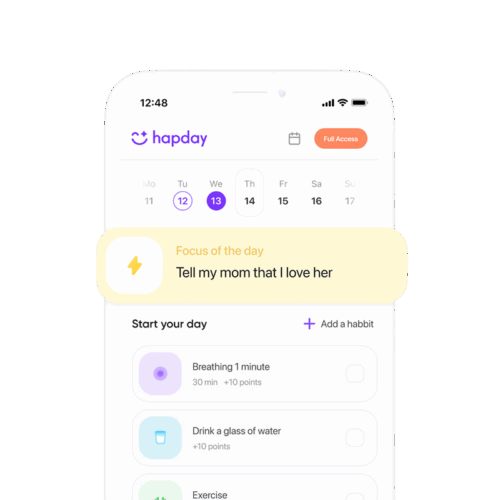
Busy schedules don’t have to cancel your calm. With mindful breaths, small movement breaks, gentle boundaries, and rituals that bookend the day, you can practice how to find inner peace during busy days in minutes, not hours. When you want structure and support between those minutes, try a guide in your pocket.
CTA: Get 24/7 guidance with Hapday AI Life Coach—personalized sessions, habit tracking, and science-backed programs to anchor your calm. Download now.
The Bottom Line
Peace isn’t a destination you reach when life slows down—it’s a practice you can return to anytime. String together small, doable moments of presence, movement, and care. Let systems and support do the heavy lifting. Over time, those threads weave a steadier nervous system and a calmer, more choiceful day.
References
- American Psychological Association, Stress in America – https://www.apa.org/news/press/releases/stress
- Harvard Health Publishing, Mindfulness meditation may ease anxiety and mental stress – https://www.health.harvard.edu/mind-and-mood/mindfulness-meditation-may-ease-anxiety-and-mental-stress
- Harvard Gazette, Eight weeks to a better brain – https://news.harvard.edu/gazette/story/2011/01/eight-weeks-to-a-better-brain/
- CDC, Benefits of Physical Activity – https://www.cdc.gov/physicalactivity/basics/pa-health/index.htm
- Mayo Clinic, Relaxation techniques: Try these steps to reduce stress – https://www.mayoclinic.org/healthy-lifestyle/stress-management/in-depth/relaxation-technique/art-20045368
- CDC, How Much Sleep Do I Need? – https://www.cdc.gov/sleep/about_sleep/how_much_sleep.html
- Harvard Health Publishing, Spending time in nature is good for you – https://www.health.harvard.edu/mind-and-mood/spending-time-in-nature-is-good-for-you
- NIH/NCCIH, Mindfulness Meditation: What You Need To Know – https://www.nccih.nih.gov/health/mindfulness-meditation-what-you-need-to-know
- World Health Organization, Mental health at work – https://www.who.int/teams/mental-health-and-substance-use/promotion-prevention/mental-health-at-work
- Harvard Health Publishing, The health effects of social isolation and loneliness – https://www.health.harvard.edu/mind-and-mood/loneliness-harms-health
Join 1.5M+ people using Hapday’s AI-powered tools for better mental health, habits, and happiness. 90% of users report positive changes in 2 weeks.