


How to Find Inner Peace After an Anxiety Spike
It often hits in ordinary moments. You’re rinsing a coffee mug or scrolling a late-night text, and then—without warning—your heart sprints. Your chest tightens. Thoughts flash like hazard lights. If you’ve been here, you know the dizzying rush that follows. And you might wonder, in the middle of it all, how to find inner peace after an anxiety spike when your whole system feels hijacked. The good news: your body isn’t broken. It’s doing exactly what it was designed to do. The even better news: you can guide it back to calm. I’ve had to learn that the long way—once during a checkout line when my palms went cold and I thought, this is it. It wasn’t.
Table of Contents
- What just happened inside your body
- First, ground your body so you can find inner peace after an anxiety spike
- Befriend your mind to find inner peace after an anxiety spike
- Make space for mindfulness so you can find inner peace after an anxiety spike
- Set gentle boundaries to protect your inner peace after an anxiety spike
- Move your body to metabolize tension and find inner peace after an anxiety spike
- Care for the story you tell yourself after a surge
- Build a small toolkit to find inner peace after an anxiety spike
- When to reach for extra help
- A note on prevention: practicing calm before you need it
- A gentle reminder you can return to
- The Bottom Line
- About the science behind these practices
- Closing encouragement
- Summary and next step
- References
Key Takeaways
- Anxiety spikes are a normal stress response; you can guide your body back to calm with breath and grounding.
- Start with body-first resets, then use CBT-style reframes to reduce catastrophic thinking.
- Mindfulness, gentle movement, and small daily boundaries steady the nervous system over time.
- Have a simple, rehearsed toolkit ready for high-stress moments.
- Seek extra support if spikes become frequent or limiting—effective treatments exist.
What just happened inside your body
Anxiety spikes are the body’s “better-safe-than-sorry” alarm. When your nervous system senses threat—real or imagined—it flips the stress switch. Harvard Medical School has described this repeatedly, most recently in 2022, as the fight-or-flight response: a cascade of adrenaline, faster heartbeat, shallow breathing, and sharpened attention, all meant to protect you from danger (Harvard Health). The problem is that modern “threats” are often emails, memories, or what-ifs, and your body can’t tell the difference. Back in 2020, The Guardian reported on the surge of panic-related searches during lockdowns—proof that context can turn ordinary days into pressure cookers.
Anxiety is common—far more common than most people realize. The National Institute of Mental Health estimates that about 19% of U.S. adults experience an anxiety disorder in a given year, and about 31% will experience one at some point in their lives (NIMH). If you’ve felt this surge, you’re not alone.
“Anxiety spikes are like false fire alarms. They’re loud and convincing, but with practice, your brain can learn to tell the difference between smoke and steam. The most compassionate thing you can do in that moment is to slow down, feel your body, and remind yourself you’re safe.”
— Dr. Lena Ortiz, Clinical Psychologist
I agree; fear thrives on speed.
First, ground your body so you can find inner peace after an anxiety spike
Why it works
When your body is in alarm mode, your prefrontal cortex—the part of your brain that reasons and plans—gets quieter. Trying to “think your way out” rarely helps in the first minute or two. You need a bridge back to safety. Breathwork and grounding techniques activate the parasympathetic nervous system, the body’s natural brake, which can slow heart rate and calm the stress response. Harvard Health notes that slow, controlled breathing can help dampen the anxiety response and support relaxation (Harvard Health). The Mayo Clinic also outlines physical strategies to ride out panic waves, reinforcing that symptoms, while distressing, are not dangerous (Mayo Clinic). In my view, this is the least glamorous skill—and the most reliable.
How to do it
- Drop into your breath. Place a hand over your heart and another on your belly. Inhale through your nose for a count of four, exhale through pursed lips for a count of six. Repeat for two minutes. Longer exhales signal safety to your nervous system, steadily calming the nervous system as your body shifts out of overdrive.
- Orient to the room. Turn your head slowly. Name five things you see, four things you feel, three you hear, two you smell, one you taste. These grounding techniques pull attention out of the thought-storm and anchor you in the present.
- Relax your jaw, shoulders, hands. Tension is your body’s way of bracing. Unclench your teeth, drop your shoulders, and let your hands rest. A softer body sends a safety cue inward.
- Add a temperature reset. Splash cool water on your face or hold a cold glass to your neck for 30 seconds. The temperature change can interrupt spiraling and help you reset.
- Make contact with the floor. Feel your feet. Press your heels down. Sway gently until you feel your weight. This subtle move reminds your brain that the ground is supporting you.
Mini-case: When Maya, 28, went through her divorce, she started waking at 3 a.m. with her heart racing. She began keeping a soft eye mask and a small bottle of lavender by her bed. “I would do the four-in, six-out breathing, roll a cool stone across my forehead, then name five things in the room I could hear,” she told me. “I still get spikes, but they pass so much faster now.” Her go-to sequence of grounding techniques wasn’t complicated. It was consistent, and it helped her find inner peace after an anxiety spike, night after night.
Befriend your mind to find inner peace after an anxiety spike
Why it works
Once your body begins to settle, your mind becomes more teachable. Anxiety often runs on catastrophic what-ifs, mental time travel, and black-and-white thinking. Cognitive behavioral strategies can interrupt these loops. Harvard Health explains that cognitive behavioral therapy (CBT) helps people recognize unhelpful patterns and replace them with more realistic, balanced thoughts (Harvard Health). When you name the fear and reframe the story, your brain receives new data: we are safe, this is tolerable, we have options. I’ve found there’s power in writing one clear sentence: Here’s what I fear, here’s what’s true.
How to do it
- Label the moment. Quietly state, “This is an anxiety spike.” Accurate naming reduces confusion and gives you a path. You’re not “going crazy.” You’re experiencing a wave that will crest and fall.
- Ask a three-part question. 1) What am I predicting? 2) What’s the evidence for and against it? 3) If the worst happened, how would I cope? This moves you from fear to problem-solving and helps restore a sense of agency.
- Write a 90-second script. Jot: “My body had a surge. It’s uncomfortable, not dangerous. I’m breathing long and slow. I’ve survived every anxious moment so far.” Keep it nearby for the next wave.
- Use a compassionate voice. Replace inner criticism with care: “Of course I feel this. It’s been a lot. I can take five minutes to breathe.” Compassion deactivates the inner threat alarm more effectively than self-blame.
“Anxiety hates specifics. The more precisely you can name the thought, the bodily sensation, and the realistic next step, the faster you reclaim your sense of stability.”
— Dr. Kevin Patel, Psychiatrist
Make space for mindfulness so you can find inner peace after an anxiety spike
Why it works
Mindfulness is the practice of paying attention to the present moment with curiosity rather than judgment. It trains the brain to notice sensations and thoughts without automatically reacting. The National Center for Complementary and Integrative Health (NCCIH) notes growing evidence that mindfulness practices can reduce stress and improve mental well-being, including anxiety symptoms (NCCIH). This isn’t about erasing worry; it’s about holding it more lightly. I think of it as widening the frame so the fear isn’t the only thing in the shot.
How to do it
- Try a three-minute reset. For one minute, notice breath. For one minute, scan the body from crown to soles. For one minute, widen attention to sounds and space around you. This gentle circuit can be done at your desk or on a bus.
- Practice “noting.” When a thought arises—“I’m going to mess this up”—silently say, “thinking,” and return to your anchor (breath, hands, feet). Each return is a rep that strengthens calm.
- Pair mindfulness with movement. A ten-minute walk, noticing the rhythm of steps and the air on your skin, helps shift focus from ruminations to sensations.
Set gentle boundaries to protect your inner peace after an anxiety spike
Why it works
The nervous system learns from rhythm and repetition. Frequent spikes often follow predictable friction points: overwork, non-stop news, too little sleep, too much caffeine. Small boundaries act like speed bumps for your stress response. The World Health Organization offers simple, evidence-informed steps for managing stress—like maintaining routines, limiting media that fuels distress, and caring for basics such as sleep and nutrition (WHO). My bias: boundaries are care, not punishment.
How to do it
- Create a re-entry ritual. After a spike, give yourself a ten-minute buffer before jumping back into email or social media. Dim lights, sip water, breathe.
- Set a caffeine cut-off. The Mayo Clinic recommends keeping daily caffeine under 400 mg for most healthy adults and notes it can worsen anxiety in some people (Mayo Clinic). Experiment with a noon cut-off or switching your second coffee to herbal tea.
- Honor sleep as medicine. The CDC emphasizes sleep’s role in emotional regulation and overall health (CDC). Aim for a steady wind-down: dim lights, a warm shower, and a screen-free last 30 minutes.
- Make “if-then” plans. If I notice my jaw clenching, then I will breathe out slowly to a count of eight. If I feel restless at my desk, then I’ll take a two-minute stretch break.
“Precommitment is powerful. When you decide ahead of time how you’ll respond to a spike, you’ve removed ten layers of decision fatigue. Your body gets the memo: we know what to do.”
— Selina Park, LMHC
Move your body to metabolize tension and find inner peace after an anxiety spike
Why it works
Muscles that brace during stress hold a kind of “echo.” Physical movement helps discharge that echo and restore equilibrium. Yoga and gentle exercise are linked to reductions in stress and anxiety symptoms for many people, as summarized by the NCCIH (NCCIH). Movement also deepens breath and returns you to your senses—two steady ways of calming the nervous system. On difficult days, go for ten quiet minutes rather than none.
How to do it
- Try “three by three.” Three minutes of shoulder rolls, three minutes of cat-cow, three minutes of slow walking.
- Choose “honest” intensity. On spike days, aim for movement that feels kind rather than punishing. Let the goal be presence, not performance.
- Take it outdoors if you can. Natural light strengthens your circadian rhythm, which supports mood and sleep.
Care for the story you tell yourself after a surge
Why it works
The meaning you assign to a spike shapes your next one. If you tell yourself, “I failed again,” your body stays braced. If you tell yourself, “A wave came and I rode it,” your system exits alarm more quickly. In reporting on this topic across the past decade, I’ve heard one theme: self-judgment keeps the loop alive; self-respect loosens it.
How to do it
- Debrief in a few lines. What triggered the wave? What helped, even a little? What will you try next time? Keep it factual and kind.
- Celebrate micro-wins. “I noticed my breath.” “I took a sip of water.” Tiny acts of steadiness are the building blocks of resilience.
- Share with someone safe. Saying out loud, “I had an anxiety spike today, and I slowed my breath,” normalizes the experience and reinforces your skills. The APA emphasizes that anxiety is common and treatable, and seeking support is a strength, not a flaw (APA).
Build a small toolkit to find inner peace after an anxiety spike
Fill a pouch or notes app with what actually works for you:
- A two-minute breath track or timer
- A grounding object (smooth stone, rubber band)
- A sentence that soothes you
- A photo that reminds you of safety
- A short playlist that helps with calming the nervous system
- A list of three people you can text: “Having a wave. Can you remind me I’ll be okay?”
Mini-case: Jamal, 33, kept getting spikes before presentations. He built a 12-minute routine: a slow walk around the block, two minutes of paced breathing, then a sticky note on his laptop that read, “It’s okay to take a sip of water.” “I used to force my way through,” he said. “Now I plan for my nervous system. I don’t always feel fearless, but I’m functional—and kinder to myself.”
When to reach for extra help
If spikes are frequent, intense, or start limiting your life—if you avoid places you’d like to go or tasks you need to do—it might be time to add more support. Evidence-based treatments like CBT and sometimes medication can help rewire the patterns that keep the alarm stuck on high (Harvard Health; NIMH). A therapist can tailor grounding techniques and thought tools to your specific triggers. You’re not meant to do this alone. I’ve seen people reclaim parts of life they thought were gone for good.
If you ever have thoughts of harming yourself, or you feel you might be in immediate danger, call or text 988 in the U.S. for the Suicide & Crisis Lifeline, or reach your local emergency number right away.
A note on prevention: practicing calm before you need it
Just like you charge your phone before it hits 1%, practice the skills that help you find inner peace after an anxiety spike when you’re relatively calm. Ten slow breaths in the morning. Five minutes of mindful walking after lunch. A two-minute body scan before sleep. These small practices train your nervous system to trust you. Over time, you may notice spikes arrive less often and pass more quickly. In 2021, a Harvard study on relaxation practices echoed this: rehearsal matters.
Mini-case: Priya, 26, started a “pause practice” on her calendar: three reminders each day to breathe and name one word for how she felt. “It was awkward at first,” she laughed. “But now my body recognizes the check-in. When a spike comes, I already know the moves.” Tiny, rehearsed acts—this is where steadiness grows.
A gentle reminder you can return to
None of this is about perfection. It’s about building a relationship with yourself that holds steady in rough weather. When the next wave rises, breathe longer out than in. Feel the floor. Name the moment. Ask what’s truly needed. Reach for support. Repeat. Step by step, you learn how to find inner peace after an anxiety spike and keep a soft light on for yourself—no matter what the day brings.
The Bottom Line
Your body’s alarm system is working—even when it feels overwhelming. With brief, practiced resets (breath and grounding), kinder self-talk, mindful awareness, movement, and gentle boundaries, you can reliably escort yourself back to center. If spikes start shaping your life, reach for professional support—effective help exists.
About the science behind these practices
- The stress response is a normal, adaptive system that can be safely downshifted with breath and body-based practices (Harvard Health).
- Slow, deliberate breathing helps reduce stress arousal and supports relaxation (Harvard Health).
- Panic symptoms are uncomfortable but not dangerous; practical strategies can help you ride out the wave (Mayo Clinic).
- Mindfulness practices can reduce stress and improve well-being for many people (NCCIH).
- CBT helps reframe unhelpful thoughts and behaviors (Harvard Health).
- Gentle movement and yoga can help with stress and anxiety symptoms (NCCIH).
- Caffeine and poor sleep can worsen anxiety; wise limits help (Mayo Clinic; CDC).
- Stress management basics—routine, boundaries, and self-care—support mental health (WHO).
Closing encouragement
When the surge comes, remember: your body is trying to protect you. You have tools now—breath, grounding techniques, mindful attention, kinder thoughts, and steady routines—to escort yourself back to center. Each time you practice, you strengthen trust in your ability to find inner peace after an anxiety spike, and you make a little more room in your life for ease.
Summary and next step
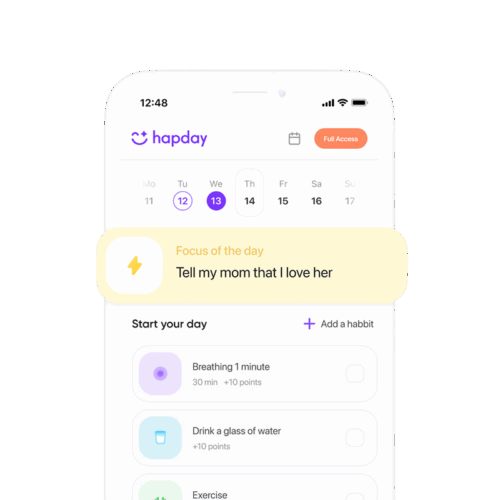
You’re not broken—you’re human. With body-first resets, mindful awareness, thoughtful reframes, and small daily boundaries, you can reliably find inner peace after an anxiety spike and rebuild a felt sense of safety. If you want friendly structure and 24/7 support right on your phone, try guided help.
Try Hapday AI Life Coach for daily calm: 24/7 guided sessions, habit tracking, and personalized programs. Download here: https://apps.apple.com/app/hapday-ai-life-coach/id1498572982
References
- Harvard Health Publishing, Harvard Medical School – Understanding the stress response: https://www.health.harvard.edu/staying-healthy/understanding-the-stress-response
- Harvard Health Publishing – Relaxation techniques: Breath control helps quell errant stress response: https://www.health.harvard.edu/mind-and-mood/relaxation-techniques-breath-control-helps-quell-errant-stress-response
- Mayo Clinic – Panic attacks and panic disorder: https://www.mayoclinic.org/diseases-conditions/panic-attacks/symptoms-causes/syc-20376021
- National Center for Complementary and Integrative Health (NCCIH) – Mindfulness Meditation: What You Need To Know: https://www.nccih.nih.gov/health/mindfulness-meditation-what-you-need-to-know
- Harvard Health Publishing – What is cognitive behavioral therapy?: https://www.health.harvard.edu/mind-and-mood/what-is-cognitive-behavioral-therapy
- National Center for Complementary and Integrative Health (NCCIH) – Yoga: What You Need To Know: https://www.nccih.nih.gov/health/yoga-what-you-need-to-know
- Mayo Clinic – Caffeine: How much is too much?: https://www.mayoclinic.org/healthy-lifestyle/nutrition-and-healthy-eating/in-depth/caffeine/art-20045678
- Centers for Disease Control and Prevention – Sleep and Sleep Disorders: Data and Statistics: https://www.cdc.gov/sleep/data_statistics.html
- American Psychological Association – Anxiety: https://www.apa.org/topics/anxiety
- National Institute of Mental Health – Any Anxiety Disorder: https://www.nimh.nih.gov/health/statistics/any-anxiety-disorder
- World Health Organization – Stress: https://www.who.int/news-room/questions-and-answers/item/stress
Join 1.5M+ people using Hapday’s AI-powered tools for better mental health, habits, and happiness. 90% of users report positive changes in 2 weeks.