


What Are Emotional Regulation Strategies?
The memory arrives in flashes: a phone lights up late, a name you didn’t expect, a message you didn’t want. Heat climbs your face before your brain catches up. Your reply flies out—too sharp, too fast—and regret lands just as hard. If this feels familiar, you’re in good company. Many of us aren’t trying to feel less; we’re trying to feel more wisely, so our inner weather doesn’t dictate our outer life.
So what are emotional regulation strategies, really? They’re practical, science-informed ways to tend to emotions so you can respond with steadiness rather than reflex. Think of a toolkit for your nervous system—brief pauses, naming, reframing, movement. The point isn’t suppression. It’s channeling feeling in ways that safeguard your health and your relationships. My view, after years reporting on this beat: we chronically underteach these skills in schools, where they would matter most.
Table of Contents
- What Are Emotional Regulation Strategies?
- A Quick Reality Check
- Why Regulating Emotions Matters More Than Being Calm
- The Science in Your Corner
- Emotional Regulation Strategies in Everyday Life: What It Looks Like
- What Gets in the Way—and How to Gently Move Through It
- Practice Notes for Real Life
- When More Support Is Wise
- A Short, Compassionate Plan to Begin Today
- Summary and Next Step
- The Bottom Line
- References
Key Takeaways
- Emotional regulation is about responding wisely to feelings, not suppressing them.
- Breathwork, naming emotions, reframing thoughts, grounding, sleep, and movement are core tools.
- Practice in calm moments builds reflexes you can access under stress.
- Boundaries and values-based actions address root causes, not just symptoms.
- Compassion and connection are powerful co-regulators—use them.
What Are Emotional Regulation Strategies?
Emotional regulation strategies are practical skills that help you work with emotions so you can respond rather than react. They calm the body, clarify the mind, and line up your actions with your values.
A Quick Reality Check
Stress and strong emotion aren’t outliers; they’re features of modern life. The American Psychological Association has tracked rising stress and its link to physical symptoms for years (APA). NIMH estimates suggest nearly 1 in 5 U.S. adults experienced major depression around 2020–2021, and anxiety disorders touch almost a third of people across a lifetime (NIMH — Depression; NIMH — Anxiety). The World Health Organization places global mental disorders at roughly 1 in 8 (WHO). In 2022, The Guardian reported on a spike in loneliness among young adults in the U.K.—not an outlier, a pattern. If you’re overwhelmed, you’re not broken; you’re human in a demanding era.
Why Regulating Emotions Matters More Than Being Calm
When Maya, 28, went through a sudden breakup, her days swung between numbness and panic. She tried to outwork the pain; every Slack ping detonated a fresh wave of dread. In therapy she met skills no one had taught her—slowing her breath, putting language to feelings, reframing catastrophes. Nothing flashy, just consistent practice. “I still felt everything,” she told me. “I just stopped spiraling.”
Emotions are data—signals about needs, values, and boundaries. Under stress, that signal can distort or arrive too loud, too fast. Regulation helps you:
- Reduce physiological arousal so your thinking brain can reengage.
- Make sense of the feeling, which naturally lowers its temperature.
- Choose responses aligned with your goals, not your adrenaline.
“Emotional regulation isn’t about becoming a robot. It widens the space between stimulus and response so you can act from your values, not from a surge.”
— Dr. Sarah Chen, Clinical Psychologist
The Science in Your Corner
Mind and body aren’t separate file folders; they’re a loop. Slow your breath and you send a safety cue through the vagus nerve. Heart rate shifts. Stress hormones settle. Relaxation skills—deep breathing, progressive muscle relaxation—reduce tension and stress physiology (Mayo Clinic). Mindfulness training improves attention and nonjudgmental awareness, lowering reactivity (Harvard Health). Reframing—cognitive reappraisal—changes how the brain evaluates threat, dialing down anger and fear (Harvard Health). Movement matters, too; regular physical activity correlates with decreased depression and anxiety symptoms (CDC). You’re not crossing your fingers; you’re engaging levers we can name. My bias? Breath is still the most underused, portable intervention we have.
Emotional Regulation Strategies in Everyday Life: What It Looks Like
Image alt: young adult journaling by a window, practicing emotional regulation strategies
-
The mindful micro-pause
Why it works: Intense emotion narrows attention and spikes arousal. A micro-pause interrupts momentum, allowing prefrontal regions—the planning and perspective hubs—to come back online. Brief breath practices calm the nervous system and cut cognitive noise (Mayo Clinic).
How to try it: When you feel the surge, silently say “Pause.” Inhale through your nose for four counts, exhale for six. Three cycles. Notice one body sensation and one sound in the room. Don’t fix anything; simply orient to now.
Case example: Jordan, 31, used this before contentious work calls. “Two minutes of breath changed the tone. I didn’t go in braced for battle.”
Pro Tip: Put “Pause” on your phone lock screen or watch face to cue the habit exactly when you need it. -
Name it to navigate it
Why it works: Labeling an emotion recruits language and meaning-making systems, often reducing raw intensity. “I’m feeling shame and fear,” not “I feel awful,” clarifies needs.
How to try it: Use a simple script: “I notice a tight chest (body), I’m thinking I messed up (thought), I’m feeling anxious and ashamed (emotion), and I need support/clarity (need).” The APA describes emotion regulation as monitoring, evaluating, and modifying reactions—naming is foundational (APA Dictionary).
-
Gentle reframing (cognitive reappraisal)
Why it works: Thoughts are lenses. Distorted lenses—“I’ll be fired for one mistake”—make the body act as if danger is certain. Reappraisal swaps catastrophe for balance, and research links it to better mood and coping (Harvard Health).
How to try it: Ask, “What’s the most compassionate, realistic way to see this?” Try: “I made one mistake. I can correct it and communicate early.” Write the fear-story and the balanced-story. Choose actions that fit the latter.
-
Grounding and sensory soothing
Why it works: When emotions spike, concrete sensory input says, “We’re safe in this moment.” Dialectical behavior therapy popularized distress tolerance: grounding, temperature shifts, paced breathing—skills that help you ride the wave without making it worse (APA — DBT).
How to try it: Hold an ice cube. Splash cool water. Name five things you can see, four you can feel, three you can hear, two you can smell, one you can taste. Build a soothing kit: a calming scent, a playlist, a smooth stone, tea.
-
Movement as medicine
Why it works: Exercise releases mood-supportive neurochemicals and can dampen stress hormones. Even short walks can interrupt rumination (CDC).
How to try it: Commit to 10 minutes: brisk walk, stretch flow, or simply shake out arms and legs to discharge tension. When you think you don’t have time, borrow it from scrolling.
-
Boundaries and values-based action
Why it works: Some emotions flag crossed boundaries or neglected values. Regulate the feeling without addressing the cause and you’re kicking the can.
How to try it: Ask, “What is this emotion pointing to?” If anger surfaces every time you open email at 10 p.m., the strategy may be a boundary: no after-dinner work two nights a week.
-
Sleep, nourishment, and the basics that quietly change everything
Why it works: Sleep deprivation turbocharges reactivity and blunts regulation. Adults need at least 7 hours nightly for optimal functioning (CDC — Sleep). Nutrition and hydration steady energy and mood, supporting every other tool.
How to try it: Set a steady sleep window and a wind-down free of doomscrolling. If you crash mid-afternoon, add a snack with protein and complex carbs.
-
Compassion, not criticism
Why it works: Harsh self-talk spikes threat physiology and fuels avoidance. Compassionate self-coaching lowers defensiveness and keeps you engaged. Mindfulness and self-kindness are associated with less stress and better coping (Harvard Health).
How to try it: Swap “What’s wrong with me?” for “What do I need right now?” Speak to yourself as you would to a dear friend.
-
Connection as co-regulation
Why it works: Humans regulate in relationship. A steady voice and grounded presence send powerful safety cues. Social support tracks with better health outcomes (CDC — Social Support).
How to try it: Keep a “reach-out” list in your phone for different needs—the listener, the laugher, the problem-solver. Emotional regulation isn’t only solo practice; it’s shared practice.
What Gets in the Way—and How to Gently Move Through It
Maybe you’ve tried and felt discouraged. You breathe and the panic doesn’t vanish. You reframe and your mind argues back. That’s okay.
“Regulation isn’t a light switch; it’s a volume knob. If you turn it from a 9 to a 6, that’s success. From there, you choose your next wise step.”
— Dr. Miguel Alvarez, Board-Certified Psychiatrist
Common blockers:
- All-or-nothing goals: Expecting instant calm sets you up to quit. Aim for “calmer” or “more choice.”
- Skills without systems: If you only practice during crises, your brain won’t reach for them under pressure. Rehearse in neutral moments to build reflexes.
- Unmet needs upstream: No technique can override chronic sleep loss, isolation, or unsafe settings. Sometimes the most effective “strategy” is structural—different schedules, clearer limits, better rest.
Practice Notes for Real Life
- Pair skills: Name the feeling, breathe, then take a 5-minute walk. Stacking tools often beats a single tactic.
- Timebox rumination: Give your mind 10 minutes to worry on paper, then write one next action. Containment tempers spirals.
- Use visual anchors: A sticky note—“Breathe and name it”—where you get triggered: laptop, mirror, dashboard.
- Track what helps: Keep a short log of situations, feelings, and what worked. Data is empowering on rough days.
When More Support Is Wise
If emotions feel unmanageable, intrusive, or lead to self-harm or substance use, please reach out. Evidence-based therapies change lives. Cognitive behavioral therapy teaches reappraisal and behavior shifts; dialectical behavior therapy builds distress tolerance and emotion skills (APA — DBT).
In the U.S., call or text 988 for the Suicide & Crisis Lifeline.
“We don’t earn care by suffering enough. Seeking support is itself regulation—it’s choosing relationship over isolation.”
— Dr. Leila Thompson, Behavioral Health Researcher
A Short, Compassionate Plan to Begin Today
- Morning: One mindful minute while the coffee brews. Feel your breath, name your mood, set a small intention.
- Midday: Ten minutes of walking or stretching. Pick one work boundary to honor for the afternoon.
- Evening: Journal prompt—“What emotion visited today? What did it need?” Choose one soothing activity—music, warm shower, or tea—before screens.
Summary and Next Step
Emotional regulation strategies calm the body, clarify the mind, and align actions with values. Start with micro-pauses, naming emotions, reframing thoughts, grounding the senses, and protecting sleep and movement. Practice gently and consistently to build resilience and choice.
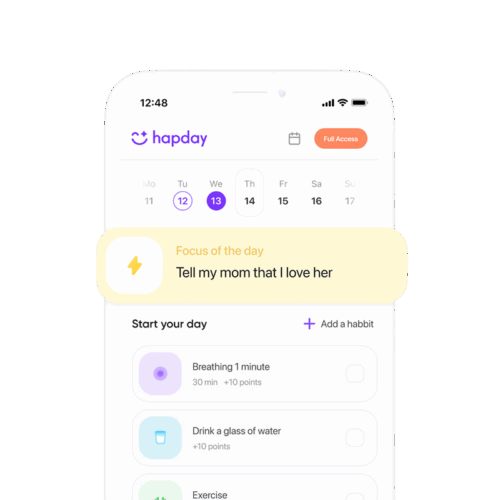
CTA: Get personalized, 24/7 support with Hapday AI Life Coach—guided sessions, habit tracking, and tailored wellness plans. Download here: https://apps.apple.com/app/hapday-ai-life-coach/id1498572982
The Bottom Line
If something feels like too much, take one breath and choose one step. These skills meet you where you are and widen the path forward—one cue of safety, one compassionate thought, one boundary at a time. Over weeks, you’ll notice more choice, groundedness, and self-trust. That’s not just coping. That’s growth.
References
- American Psychological Association (APA) — Stress: https://www.apa.org/topics/stress
- APA Dictionary of Psychology — Emotion regulation: https://dictionary.apa.org/emotion-regulation
- National Institute of Mental Health (NIMH) — Major depression: https://www.nimh.nih.gov/health/statistics/major-depression
- NIMH — Anxiety disorders: https://www.nimh.nih.gov/health/topics/anxiety-disorders
- World Health Organization (WHO) — Mental disorders: https://www.who.int/news-room/fact-sheets/detail/mental-disorders
- Harvard Health Publishing — Mindfulness and stress: https://www.health.harvard.edu/blog/mindfulness-meditation-may-ease-anxiety-mental-stress-201401086967
- Harvard Health Publishing — Reframing negative thoughts: https://www.health.harvard.edu/mind-and-mood/reframing-negative-thoughts
- Mayo Clinic — Relaxation techniques: https://www.mayoclinic.org/healthy-lifestyle/stress-management/in-depth/relaxation-technique/art-20045368
- CDC — Physical activity and health: https://www.cdc.gov/physicalactivity/basics/pa-health/index.htm
- CDC — How much sleep do I need?: https://www.cdc.gov/sleep/about_sleep/how_much_sleep.html
- APA — Dialectical behavior therapy: https://www.apa.org/ptsd-guideline/patients-and-families/dialectical-behavior-therapy
Join 1.5M+ people using Hapday’s AI-powered tools for better mental health, habits, and happiness. 90% of users report positive changes in 2 weeks.