



9 Ways to Build Personal Growth Habits Daily
The first time I tried to reset my life, I set six alarms, stacked three new journals by my bed, and color‑coded a schedule that lasted exactly… two days. That was 2016, a dark winter when I thought discipline alone would save me. If you’ve been there—stretching for a new version of yourself and feeling the rubber band snap back—you’re in very human company. Real change almost never appears with a drumroll. It grows quietly from small, repeatable moves. That’s the durable truth of personal growth habits: less about reinvention, more about reliable touch points that leave you sturdier today than yesterday.
If you’re navigating stress, anxiety, or burnout, the idea of “building” anything daily may sound like one more burden. Shrink the frame. Think kinder. Picture a day as a string of gentle anchors, not a to‑do marathon. This is where personal growth habits shine: humble, science‑backed, and designed to fit the life you’ve got—no perfect charts, no overnight transformations. I’d argue the real flex is steadiness, not intensity.
Table of Contents
- Why tiny beats grand when it comes to personal growth habits
- 1) Start smaller than you think: the two-minute “starter ritual”
- 2) Take breathing micro-breaks to reset your nervous system
- 3) Move your body—especially outdoors—most days
- 4) Protect your sleep like the keystone it is
- 5) Keep a one-line gratitude or wins journal
- 6) Set gentle boundaries with your screens
- 7) Practice a 60-second self-compassion check-in
- 8) Learn in tiny doses to keep your mind flexible
- 9) Send one micro-connection or do one kind act
- Make your environment do the heavy lifting
- A weekly “reset” keeps daily personal growth habits humming
- What this can look like in real life
- Two reminders when it gets hard
- Why this approach is sustainable
- Summary and gentle next step
- Get ongoing guidance with Hapday AI Life Coach
- Closing encouragement
- The Bottom Line
- References
Key Takeaways
- Tiny, repeatable actions compound faster and more sustainably than intense overhauls.
- Link habits to existing cues and keep them friction-light for real-life follow-through.
- Sleep, breathwork, movement, and connection regulate your nervous system and mood.
- Self-compassion and gratitude anchor resilience and make habits more repeatable.
- Adjust weekly: make hard habits smaller and celebrate small wins to keep momentum.
Why tiny beats grand when it comes to personal growth habits
Habits help your brain save energy. Each repeat whispers, “This matters—make it easier.” Psychologists often explain this as cue‑behavior‑reward: a small action, tied to a reliable reminder and a quick feel‑good signal, turns a choice into something close to automatic over time.
“When you’re stressed, your brain craves predictability. Habits that stick are friction‑light and emotion‑friendly. If they soothe you or give you a small win fast, you’ll return.”
— Dr. Sarah Chen, Licensed Clinical Psychologist
The American Psychological Association has long advised breaking change into manageable steps and using clear prompts to improve follow‑through and durability; their 2021 guidance still holds up. Below are nine daily anchors. Each one covers why it works (the science) and how to weave it into your day without turning your life upside down. My view: choose two. Depth over breadth.
Image alt: Morning light, journal, and tea—personal growth habits made gentle
1) Start smaller than you think: the two-minute “starter ritual”
Why it works: The brain resists big swings when you’re overwhelmed. Micro‑actions lower the mental “activation energy.” Even a two‑minute starter ritual—opening your notebook, lacing your shoes—primes the mind with a quick hit of progress, which invites repetition. The APA has repeatedly underscored that small, consistent steps build momentum and resilience. I’d go further: starter rituals are the unsung engine of behavior change, more reliable than a weekend boot camp.
How to do it daily:
- Tie the action to one anchor you already do (pour coffee, brush teeth).
- Examples: After coffee, write one line of intention. After brushing, do 10 slow breaths. Post‑commute, read a single page.
- Let it be “minimum viable growth.” Two minutes is a win; anything extra is bonus, not obligation.
2) Take breathing micro-breaks to reset your nervous system
Why it works: When stress spikes, the sympathetic nervous system accelerates heart rate and thought speed. Slow, intentional breathing nudges the parasympathetic “rest‑and‑digest” system, reducing arousal. The NIH’s integrative health center describes relaxation breathing as a simple tool to lower stress; Harvard Health has reported that mindfulness practices can ease anxiety and mental strain. My take: breathwork is the most portable reset you own.
How to do it daily:
- Three times a day, pause for one minute: inhale for 4, exhale for 6, repeat 6–8 cycles.
- Use natural cues: every time you unlock your phone or sit down to eat, take one breathing minute.
- On hard days, place a hand over your heart as you breathe. Touch can amplify the signal of safety.
3) Move your body—especially outdoors—most days
Why it works: Exercise reliably shifts mood. The Mayo Clinic notes that physical activity can ease anxiety and depression symptoms, and support better sleep and confidence. The World Health Organization recommends 150–300 minutes of moderate activity weekly; the case for movement is overwhelming. Personally, I think a short walk outperforms most wellness fads.
How to do it daily:
- Take a 10‑minute “mood walk” after lunch or between meetings. Sunlight or leaves help.
- Keep shoes by the door and a playlist ready to reduce friction.
- On busy days, sprinkle movement: 3‑minute stretch breaks, a set of squats while coffee brews, a stair climb between calls.
Mini story: When Jordan, 32, felt burnout’s edge in April 2022, he committed to a 12‑minute loop around his block at 4 p.m.—no matter what. “It was short enough that I couldn’t talk myself out of it,” he told me. By week three, the afternoon brain fog lifted. Sleep followed.
4) Protect your sleep like the keystone it is
Why it works: Sleep stabilizes mood, sharpens attention, and restores energy. The CDC recommends at least 7 hours for most adults and points to consistent schedules and screen‑free wind‑downs as simple levers. Poor sleep heightens anxiety and blunts emotional regulation; it makes every hill feel steeper. If there’s a single habit that lifts all others, it’s this one.
How to do it daily:
- Set a “digital sunset” 60 minutes before bed to reduce blue light and mental churn.
- Create a 10‑minute wind‑down: dim lights, stretch, write one worry you’ll revisit tomorrow, read a few calming pages.
- Wake and sleep at consistent times—even on weekends—to anchor circadian rhythm.
“Treat sleep like a standing appointment with your future self. Most people are one or two habits away—no screens late, consistent wake time—from a dramatically different baseline.”
— Dr. Miguel Alvarez, Board‑Certified Sleep Medicine Specialist
5) Keep a one-line gratitude or wins journal
Why it works: Under stress, the brain scans for threats. Gratitude redirects attention toward what’s working, broadens perspective, and boosts positive affect. Harvard Health has linked gratitude practices with greater happiness, stronger relationships, and healthier markers. As a reporter and a person, I’ve seen one line a night change the emotional weather.
How to do it daily:
- Each evening, write one sentence: “Today I’m grateful for…” or “A small win was…”
- If writing isn’t your medium, take a photo of one good moment and keep a “good file” on your phone.
- Pair gratitude with your wind‑down to steady mood before sleep.
Case in point: When Maya, 28, endured a hard breakup in late 2021, she started a nightly “three slow breaths + one line” ritual. “The first week felt forced,” she told me. “By week two, my system was less on edge at bedtime. Days weren’t easier, but I felt sturdier.” I believe forced can be the doorway to real.
6) Set gentle boundaries with your screens
Why it works: Endless scrolling overloads attention, stirs comparison, and disrupts sleep—especially at night. The CDC’s sleep hygiene advice explicitly recommends device boundaries before bed to protect melatonin and sleep quality. Clear digital edges lower cognitive clutter and help you return to the room you’re in. In my book, this is modern self‑defense.
How to do it daily:
- Use app timers for social media; put your phone in another room during meals.
- Keep a minimal home screen: one folder labeled “Later.”
- Designate a daily screen‑free block (start with 15–30 minutes). Guard it like a meeting with yourself.
7) Practice a 60-second self-compassion check-in
Why it works: Harsh self‑talk spikes stress and drains motivation. Self‑compassion—treating yourself as you would a friend—correlates with lower anxiety, better coping, and steadier drive. Harvard Health has urged readers to try it as a practical tool for balance. My view: self‑compassion isn’t soft; it’s strategic.
How to do it daily:
- Hand over heart, name what’s hard (“This deadline is intense”), normalize (“Stress is part of being human”), and offer support (“I’m doing the best I can; one step at a time”).
- Tie this to breath breaks or mirror time each morning.
- After a mistake, ask, “What would future‑me appreciate I do next?”
“Self‑criticism masquerades as discipline, but it usually backfires. Self‑compassion turns down the alarm so you can hear the signal—what actually needs your care right now.”
— Priya Desai, MS, Mindfulness Educator
8) Learn in tiny doses to keep your mind flexible
Why it works: Cognitive engagement—learning a skill, reading, practicing a language—supports brain health and psychological well‑being. The National Institute on Aging notes that staying mentally active can help maintain attention and processing as we age; curiosity supports purpose at any stage. Five minutes beats none. Every time.
How to do it daily:
- Read one page or watch a 5‑minute tutorial. Keep a book or app cued up.
- Stack learning onto a routine: first coffee sip = one paragraph; transit time = one micro‑lesson.
- Track streaks for fun, not pressure—“I’m a person who learns daily,” not “I must do 30 minutes.”
9) Send one micro-connection or do one kind act
Why it works: Social connection and kindness are built‑in mood regulators. The American Psychological Association has highlighted research showing small acts of kindness can lift emotional well‑being for givers and receivers alike. In 2023, The Guardian reported similar findings from UK community projects after lockdowns. I suspect we underestimate how much a single generous note steadies both sides.
How to do it daily:
- Text a friend, send a 30‑second voice note, or write a brief compliment email.
- Do one quiet kindness: hold the door, let someone merge, offer a specific thank‑you.
- Anchor it: after lunch, ask, “Who needs a little light from me today?”
Make your environment do the heavy lifting
The less you rely on willpower, the better your personal growth habits will stick. Small environmental tweaks do the heavy lifting for you.
- Put tools in sight: journal on your pillow, walking shoes by the door, water bottle at your desk.
- Use friction wisely: log out of social media; keep books easier to open than apps.
- Bundle rewards: pair an unpleasant task with a pleasant cue (favorite tea + budgeting, sunny spot + learning).
Dr. Chen offered a final metaphor I can’t shake: “Treat your day like a garden. You don’t control the weather; you keep tending the small things that help good things grow.” It’s ordinary work. And it’s enough.
A weekly “reset” keeps daily personal growth habits humming
Even the steadiest routine needs a little maintenance. A 15‑minute weekly reset protects your intentions and restores focus.
- Review: Which small habits felt nourishing? Which felt heavy?
- Adjust: Make hard habits smaller and easier. Move them to a better time.
- Celebrate: Note two ways you showed up for yourself. Positive reinforcement deepens the groove.
What this can look like in real life
Picture a calm Tuesday.
- Morning: You wake at your usual time, sip water, and take one minute of slow breathing. You write a single line: “Today I want to move with patience.”
- Midday: You take a 10‑minute walk, phone away, eyes on the sky. You text a friend: “Thinking of you—rooting for your interview.”
- Afternoon: You open your learning app and finish a 5‑minute lesson while a file uploads.
- Evening: You set a digital sunset. In dim light, you write one gratitude line, stretch, and close your eyes near your usual time.
Not flashy—deeply regulating. In a month, it compounds.
Two reminders when it gets hard
- Expect human days. Missed a habit? You didn’t fail. Habits are averages, not streaks. Pick the next tiny step and begin again.
- Choose depth over breadth. Two or three daily anchors practiced consistently will outpace ten scattered efforts every time.
Why this approach is sustainable
- It respects biology: slow breathing, sleep protection, movement, and connection regulate the nervous system and support emotional balance (NIH/NCCIH; CDC; Mayo Clinic; APA).
- It fits real life: micro‑habits tuck into routines with minimal friction.
- It rewards itself: moments that feel good—gratitude, compassion, a friendly text—pull you back to repeat.
Summary and gentle next step
Small, science‑backed actions—breathing breaks, short walks, sleep rituals, gratitude, self‑compassion, learning, and connection—can anchor your day and steadily lift your mood and resilience. Choose one, make it tiny, and attach it to an existing routine. You’ll build momentum without burnout. Bold step: Try guided support with a 24/7 coach.
Get ongoing guidance with Hapday AI Life Coach
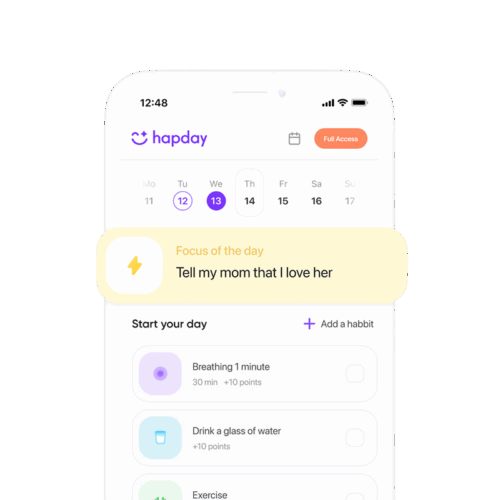
Get ongoing guidance with Hapday AI Life Coach: personalized sessions, habit tracking, and gentle programs to keep you steady. Download on the App Store.
Closing encouragement
You don’t have to become a different person to feel better. You just keep returning—gently, consistently—to the tiny actions that align who you are with how you move through a day. Let your personal growth habits be humble and human. You’ll be surprised by what compounds when you give yourself a simple, steady way forward.
About the author’s note on personal growth habits: Start where you are. Let your daily anchors be small, kind, and connected to what you already do. Over weeks, these personal growth habits will give you a more grounded nervous system, clearer focus, and a steadier sense of yourself—exactly what you need to meet whatever comes next. It’s not magic; it’s maintenance.
The Bottom Line
Pick one tiny habit, tie it to something you already do, and keep it kind. Protect sleep, breathe slowly, move a little, and connect with someone daily. Small, soothing reps—not big pushes—build the calm, resilient baseline you’ve been hoping for.
References
- Harvard Health Publishing – Mindfulness meditation may ease anxiety and mental stress
- Mayo Clinic – Exercise and stress: Get moving to manage stress
- World Health Organization – Physical activity
- Centers for Disease Control and Prevention – How Much Sleep Do I Need?
- Centers for Disease Control and Prevention – Sleep Hygiene
- NIH/National Center for Complementary and Integrative Health – Relaxation Techniques: What You Need To Know
- Harvard Health Publishing – Giving thanks can make you happier
- American Psychological Association – Random acts of kindness can boost emotional well-being
- Harvard Health Publishing – Try self-compassion
- NIH/National Institute on Aging – Cognitive Health and Older Adults
- American Psychological Association – Making lifestyle changes that last
Join 1.5M+ people using Hapday’s AI-powered tools for better mental health, habits, and happiness. 90% of users report positive changes in 2 weeks.